

Etsy listing titles now follow updated guidance that rewards clear, buyer-friendly wording over packed keywords. Etsy wants the noun and your top descriptors up front, with extras like “gift for him” moved to tags. An optional AI tool can suggest compliant titles, but you decide what gets published.
If you sell on Etsy, you have probably seen the notice about updated title advice. Etsy now points sellers toward titles that read like plain language instead of a wall of keywords, and it added an optional tool that drafts suggestions for you. Here is what the change means in practice, which rules still apply, and how to rewrite your Etsy listing titles without guessing.
What Changed in Etsy’s Listing Title Guidance?
Etsy shared new guidance describing what makes a strong listing title, then rolled out an optional AI tool that reads your current title, first photo, and description and suggests a cleaner version. According to Etsy’s Seller Handbook, buyers say clear, easy-to-scan titles help them feel more confident about what they are buying. The shift is a response to years of keyword-heavy titles. For a long time Etsy search leaned hard on the title field, so sellers crammed in every phrase they could fit.
The updated advice moves that weight toward readability. Instead of writing for the algorithm and hoping a shopper can decode it, you write for the shopper first, and the algorithm follows. This lines up with how Etsy has framed its wider set of updates for sellers, which you can read about in its Fall 2025 announcement.
📌 Did You Know?
Etsy has said openly that its search once placed heavy emphasis on the title, which pushed some sellers to pack in keywords. The updated guidance is meant to reward titles a person can actually read, so a clear phrase now competes better than a long keyword string.
How to Write Etsy Titles the New Way
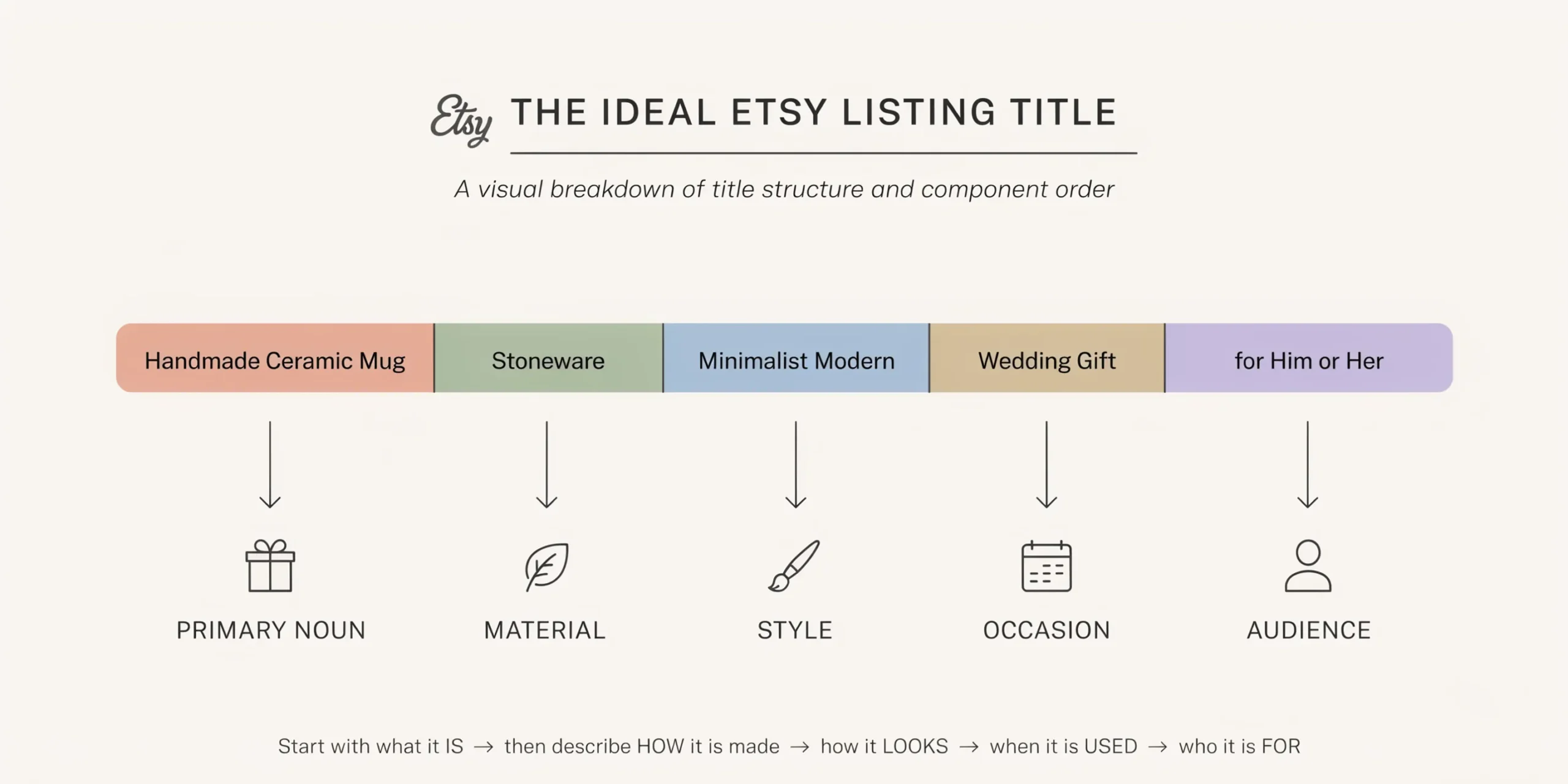
Start with the noun. Name what the item actually is, like ceramic mug, linen apron, or enamel pin, and put it near the front. Add your top two or three objective descriptors next, the details a buyer would care about such as color, size, or material. That gives you a title like “Ceramic Coffee Mug Handmade Speckled Blue 12oz,” which tells a shopper what they are looking at in a single glance.
Keep the phrasing natural. If you would not say it out loud to a customer, it probably does not belong in the title. This is also the fastest way to optimize Etsy titles for mobile, where only the first part of the title shows before it gets cut off.
💡 Pro Tip
Front-load your strongest descriptor inside the first 40 characters, since that is the slice Etsy shows in mobile search and Google previews. Sellers who bury the main phrase at the end of a long title often lose the click before a buyer ever taps through.
What Goes in the Title, What Moves to Tags, What to Cut

Etsy’s guidance is easier to apply when you sort each part of your old title into three buckets. A detailed breakdown by eRank lines up with what the Seller Handbook recommends:
| Title element | Example | Where it belongs now |
|---|---|---|
| The core noun | mug, dress, ring | Keep it, near the front |
| Top objective descriptors | color, size, material | Keep it in the title |
| Aspirational phrases | gift for him, birthday present | Move to tags or attributes |
| Subjective words | beautiful, perfect, stunning | Move to tags or attributes |
| Selling and shipping terms | on sale, free shipping | Remove from the listing |
| Repeated words or phrases | cotton poncho, unisex poncho | Cut the duplicates |
⚠️ Common Mistake to Avoid
The old habit of repeating a phrase in different orders, like “unisex adult poncho, unisex cotton poncho,” no longer helps and now works against you, since Etsy already understands a word once it appears. Move aspirational terms such as “gift for mom” into tags, keep subjective words like “beautiful” out of the title, and drop selling language like “free shipping” entirely.
Etsy Title Character Limit and Formatting Rules
You still get 140 characters for a title, and that has not changed with the new guidance. What changed is how you should spend them. You do not need to fill every slot. A clear 70 to 100 character title that front-loads a real phrase often reads better, and converts better, than a padded title stretched to the maximum.
Etsy’s search still reads the whole title, but shoppers rarely do, so the opening matters most. If you write clean Etsy SEO titles that lead with the noun and a couple of descriptors, you satisfy both the reader and the algorithm without stuffing.
📐 Technical Note
Etsy allows up to 140 characters for a title, and letters, numbers, spaces, and punctuation all count toward that limit. The first 40 or so characters are the ones that appear in mobile search results and Google previews. Etsy’s optional title tool builds its suggestions from your current title, first photo, and description, and for now it works only on listings written in English.
Where Your Keywords Belong: Titles vs Tags
Your title is not the only place Etsy looks. Tags do a lot of the search work too, and the new guidance leans on them. You get 13 tags, each up to 20 characters, so treat them as the home for everything you pulled out of the title. Put occasion and gift phrases here, along with synonyms a shopper might type.
Skip single words like bag or mug, since broad terms are hard to rank for, and use multi-word phrases instead. One rule saves you from wasting slots: do not repeat your exact title wording in your tags. Etsy already credits those words from the title, so tags are better spent on related phrases that did not fit.
Using an Etsy Title Tool to Move Faster
Etsy’s own title tool is the quickest way to try the new guidance. It suggests a buyer-friendly version of each title and can update several listings at once, though Etsy is clear that it offers a starting point, not a directive. Test it on one listing, see if you like the result, then decide whether to apply it more widely.
An Etsy title tool is most useful when you pair it with real market context. Before you rewrite, it helps to see how listings that are actually selling in your niche word their titles. A trend tracker like Podkon follows live Etsy best-sellers and shows each top listing’s title next to the tags it ranks for. Because every Etsy review marks a completed sale, the demand it reports is confirmed rather than guessed, which makes it a solid reference for the phrases buyers actually respond to.
Where to Go From Here
Your Next Step: Pull up your three best-selling Etsy listing titles and read only the first 40 characters of each. If those characters do not lead with the noun and one real descriptor, rewrite them first, move any gift or occasion phrases into tags, and cut selling language like “on sale.” Run one of them through Etsy’s title tool to compare, then work through the rest of your shop a few listings at a time.
Platform requirements and policies change often. Always check the current guidance on Etsy itself before applying bulk edits.
Frequently Asked Questions About Etsy Listing Titles
What is the Etsy title character limit?
Etsy allows up to 140 characters in a listing title, including spaces and punctuation. You do not have to use all of them. Since only the first 40 or so characters show in mobile search and Google, the opening of your title carries the most weight.
How many keywords should an Etsy title have?
Aim for one clear phrase built from the noun and two or three real descriptors, rather than a list of every keyword you can think of. Extra keywords, synonyms, and occasion terms belong in your 13 tags. This keeps the title readable while still covering more searches through tags.
Do I have to use Etsy’s new title tool?
No. The tool is optional and only suggests titles, so nothing changes until you approve it. Etsy describes it as a starting point rather than a rule. Trying it on a single listing first is a low-risk way to see whether its suggestions fit your product and your voice.
Will editing my titles hurt my search ranking?
Careful edits are unlikely to hurt, and a clearer title often helps. The title is one of Etsy’s strongest ranking signals, so make deliberate changes that keep your best phrase up front instead of rewriting everything at random. If you update a lot of listings, space the changes out and watch how each one performs.