

Low competition Etsy niches are categories where buyer demand clearly outpaces the number of quality listings. The goal is not an empty market, it is an underserved one. You want steady searches and weak, generic competitors you can beat with a sharper product, better photos, and tighter keywords.
Most “low competition niche” lists get this backwards. They hand you a category that looks empty because nobody buys there, then call it an opportunity. A quiet shelf and a profitable gap are not the same thing. This guide shows you how to define low competition honestly, where the real underserved niches sit right now, and how to check supply with live data before you commit a single listing fee.
What “low competition” actually means on Etsy
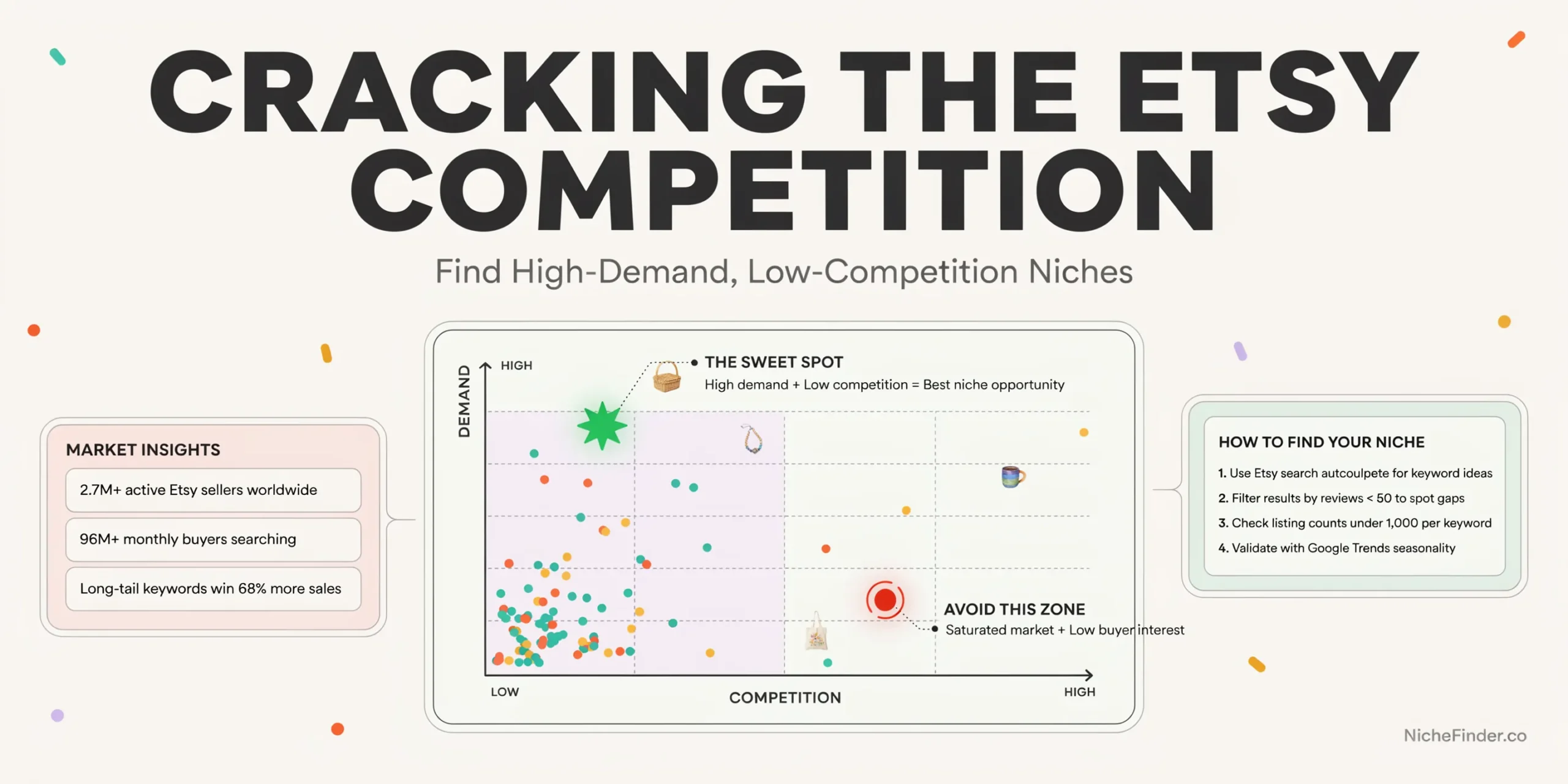
Competition on Etsy is a ratio, not a headcount. A niche is worth entering when demand is high relative to the supply of good listings, not when the total number of listings is small. Two numbers matter: how many people search for the item, and how many sellers already serve that search well.
Etsy is not a small pond. The marketplace reported roughly 86.5 million active buyers and over 100 million active listings as of its Q4 and full-year 2025 results. With that much supply, almost no category is truly empty. Your edge comes from finding searches where the existing results are weak, dated, or all look the same.
So “low competition” really means one of three things: few sellers serving a specific long-tail search, many sellers but low quality (bad photos, thin titles, no reviews), or a fast-rising trend that supply has not caught up to yet. Each is beatable. A niche with no searches at all is none of those, it is just dead.
⚠️ Common Mistake to Avoid
Treating “low competition equals no demand” as a win. If you search a term and see almost nothing, that usually means almost nobody is buying it, not that you found an untapped goldmine. Before you celebrate an empty result page, confirm people are actually searching and spending in that space. No demand is not a gap, it is a dead end.
How to tell a real gap from a dead market

Use a simple two-axis check before you build anything: demand and competition. You only want the corner where demand is moderate-to-high and competition is low. Everything else is a trap of one kind or another.
The four-quadrant test
- High demand, low competition: the prize. Rare, usually a niche inside a niche or a fresh trend.
- High demand, high competition: crowded but viable if you differentiate hard (jewelry, wall art).
- Low demand, low competition: the trap. Looks open, nobody is buying. Skip it.
- Low demand, high competition: avoid entirely. Saturated and shrinking.
To place a niche on this grid you need three quick signals. First, search demand: does the term auto-complete in Etsy search, and do related searches appear? Second, listing supply: how many results, and how strong are the top ten? Third, recency: are the best-sellers recent, or are top listings years old with stale photos? An old top result with thousands of sales but a tired design is a clear opening.
📈 Trend Signal
Gift-driven searches dominate Etsy. Etsy’s own Seller Trend Report and search data show terms like “personalized gift” and “last minute gifts” pulling six-figure monthly search volumes heading into the holiday season. The opening is not the broad term, it is the specific gift moment most sellers ignore, like gifts for a new dog owner or a first apartment.
Underserved Etsy niches worth a closer look

The niches below share a pattern: clear buyer intent, a giftable angle, and top results that are easy to outclass. Treat these as starting points to validate, not a finished shopping list. Demand shifts, and the whole point of this approach is to check before you commit.
Niche comparison at a glance
Here is how a handful of underserved angles stack up on demand versus competition, with notes on where the actual gap sits.
| Niche | Demand | Competition | Notes |
|---|---|---|---|
| Personalized pet memorial items | High | Medium | Strong emotional intent, but most listings are generic. Breed-specific or photo-based designs stand out. |
| Hobby-specific organizers (crochet, fishing, baking) | Medium | Low | Each hobby is its own micro-market. Buyers are passionate and underserved by mass retail. |
| First-apartment and new-home gifts | High | Medium | Big gift occasion, but most results are generic home decor. A bundled “new home” angle is open. |
| Accessible and adaptive aids (low-vision, one-handed) | Medium | Low | Real unmet need, very thin supply. Requires genuine design care, not a quick mockup. |
| Niche digital planners (caregivers, freelancers, ADHD) | Medium | Medium | Generic planners are saturated. Specific audiences with named pain points are not. |
| Cultural and heritage occasion gifts | Medium | Low | Underserved holidays and traditions outside the mainstream calendar leave seasonal openings. |
Why personalization keeps opening gaps
The thread running through that table is personalization. Buyers pay more for something made for one person, and that demand is well documented outside Etsy too. A 2024 Deloitte study found that 80% of consumers prefer brands offering personalized experiences and spend more with them, and separate Medallia research put the share willing to pay more for a customized experience at 61%. On Etsy that translates into pricing power and a built-in reason to choose you over a mass-market alternative.
Personalization also fractures big crowded categories into hundreds of small ones. “Dog collar” is saturated. “Personalized collar for a senior dog with a health tag” is not. The narrower you go, the lower the real competition, as long as people are still searching for it. For more category-level direction, our guide on what to sell on Etsy walks through demand-backed product types in depth.
🛍️ Real Example
Pet products show the pattern clearly. Broad pet supplies are crowded, but pet memorial and senior-pet items carry strong emotional intent with far thinner, more generic competition. A seller who designs breed-specific or photo-based memorial pieces is answering a search that mass retailers and most Etsy shops handle poorly. The product is harder to copy, and buyers are less price-sensitive when it matters this much.
How to validate competition with live data
Lists like the one above age fast. The skill that does not age is validation: checking, in real time, whether demand and supply still line up before you list. Here is the workflow.
Step one: confirm demand exists

Type your niche into Etsy search and read the auto-complete suggestions. Those are real queries buyers use, ranked roughly by frequency. If your term and its variations auto-complete and surface “related searches,” demand is real. If nothing appears, that is your first dead-market warning. Our walkthrough on Etsy product research covers how to mine these suggestions systematically.
Step two: read the competition, do not just count it
Open the top 10 to 20 results for your target term. Count is the weakest signal. Look instead at quality: are the photos professional, are titles keyword-rich, do the best-sellers have hundreds of recent reviews? If the front page is full of dim photos, vague titles, and shops with single-digit sales, you have a quality gap even if the result count is large.
💡 Seller Tip
Sort the niche by “Top Reviews” and check the dates. If the best-selling listing is several years old with a tired design and no recent refresh, the category is coasting on past momentum. That is one of the cleanest openings on Etsy: proven demand, stale supply. You compete against a snapshot, not a moving target.
Step three: check whether demand is rising or fading
A niche can pass the first two checks and still be on the way down. This is where live sales data beats a static list. Instead of guessing from a blog post written months ago, look at what is actually selling and which direction it is trending across categories. Our what’s selling on Etsy breakdown and a quick scan of a sample report show how recent sales velocity separates a rising niche from a fading fad.
🔢 Quick Numbers
- 86.5 million active buyers and 5.6 million active sellers on the Etsy marketplace as of full-year 2025 (Etsy, Inc.).
- Over 100 million active listings, so genuine empty categories are rare (Statista).
- 80% of consumers prefer brands that offer personalized experiences and spend more with them (Deloitte, 2024).
Step four: pressure-test your own listing plan
Once a niche passes, the last check is you. Can you make a noticeably better product than the top results, photograph it well, and write a title that matches how buyers actually search? Low competition only helps if your listing is the one that beats the weak incumbents. Pair this with solid Etsy SEO so the listing you worked to differentiate actually surfaces for the searches you validated.
See what’s selling on Etsy right now
Finding a low competition niche comes down to one question: is demand real and is supply still weak? Podkon tracks live Etsy best-sellers and trends across every category, so you can spot demand before you list.
✅ Key Takeaways
- Low competition means high demand relative to weak supply, not an empty market.
- An empty search result usually signals no demand, which is a dead end, not a gap.
- Use the demand-versus-competition grid and only chase the high-demand, low-competition corner.
- Personalization fractures big crowded categories into hundreds of beatable micro-niches.
- Read the top listings for quality and recency instead of just counting results.
- Validate with live sales data before you list, because static niche lists go stale fast.