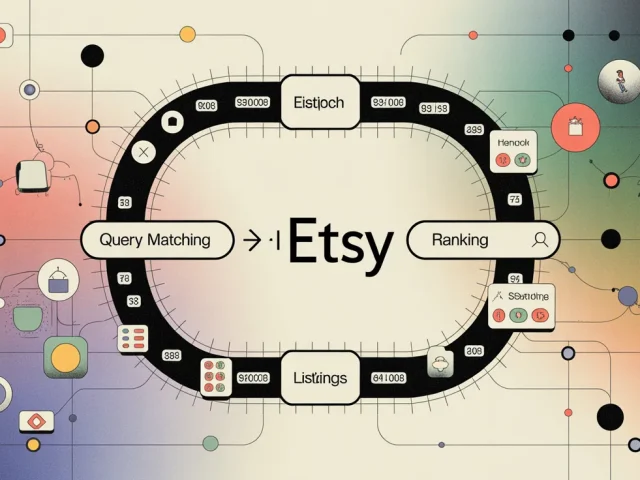


Etsy SEO is the practice of matching your listings to what buyers search for, so Etsy ranks them higher in results. Etsy weighs relevance, listing quality and engagement, recency, your shop’s customer and market experience score, and shipping price. Get those signals right across your titles, all 13 tags, attributes, categories, and photos, and you earn more placements.
Ranking on Etsy is not luck and it is not a single trick. Etsy’s search system reads dozens of signals from every listing and every shop, then orders results so shoppers see items they are most likely to buy. Your job is to feed that system clean, accurate, buyer-language data, then back it up with a shop that converts. Here is how each ranking factor works and the exact steps to act on it.
How Etsy search ranks your listings

Etsy uses information about each listing and shop to rank items so people browsing see what they are most likely to purchase first, according to the Etsy Seller Handbook. Five signals do most of the work. The table below sums them up, then we break down what each one means for your shop.
The five core ranking factors

| Factor | What Etsy looks at | Where you control it |
|---|---|---|
| Relevancy | How well your words match the query | Title, tags, description, attributes, categories |
| Listing quality and engagement | Clicks, favorites, and purchases per view | Photos, price, first listing line, reviews |
| Recency | How recently an item was listed or renewed | New listings, steady fresh inventory |
| Customer and market experience | Reviews, response rate, case rate, policies | Service standards, complete shop profile |
| Shipping price | Low or free US shipping | Shipping profiles, free shipping guarantee |
Relevancy: matching the exact query

When your tags, title, description, categories, and attributes match what a shopper types, your listing becomes eligible to show. Etsy reads the query and looks for those words across your listing fields. An exact-phrase match counts more than scattered single words, so a tag like “personalized dog collar” will pull stronger for that search than the words “dog” and “collar” sitting apart.
Listing quality and engagement

Etsy tracks how shoppers react to your listing once it shows. Clicks, favorites, and purchases all feed a quality score that decides whether you keep your spot or slip. A listing that gets seen often but rarely clicked sends a weak signal. This is why your first photo and your price matter as much as your keywords.
💡 Seller Tip
A common move among top sellers is to treat the first photo as an ad, not a catalog shot. Test a lifestyle image against a plain-background one for two weeks and watch the click rate in your Stats tab. The version that earns more clicks earns better placement on its own.
Recency and the new-listing boost

Recency is how recently you listed or renewed an item. New listings get a small, temporary boost so Etsy can gather data on how buyers respond, then it sets a longer-term quality score. That boost is short, so renewing a poor listing over and over will not save it. Use the boost to test fresh products and strong listings, not to paper over weak ones.
Customer and market experience score
Shops that follow Etsy’s service standards rank ahead of shops that do not. Etsy weighs your average review rating, message response rate, and case rate from the past three months, as described in its guidance on customer service and search. A complete shop also helps, including a shop photo, an About section, and clear return policies. Buyers trust complete shops, and so does the algorithm.
Shipping price
Shipping cost is a direct ranking factor for US listings. Etsy prioritizes eligible listings with US domestic shipping under $6, including free shipping, per its shipping price update. A free shipping guarantee on orders of $35 or more also earns priority placement in US search. Price your product to absorb shipping where the math works, because cheaper shipping lifts both rank and conversion.
Keyword research: find the words buyers actually type
Good Etsy SEO starts with the language buyers use, not the language you use. You might call it a “minimalist line-art print,” while shoppers search “boho wall art” or “above bed decor.” Build a list of phrases that describe your item the way a buyer would say it, then rank them by demand.
Start with Etsy’s own search bar autocomplete, which surfaces real queries. Add the related searches at the bottom of a results page. Then check what is genuinely selling, not just what looks popular, so you target phrases with buyers behind them. Our walkthrough on Etsy product research shows how to pull demand signals before you commit a listing slot.
📈 Trend Signal
Search demand shifts fast, especially around seasons and viral moments. A keyword that converted in spring can flatten by summer. Tracking which listings and phrases are climbing right now keeps your titles aligned with live demand instead of last year’s bestseller lists.
This is where live data beats static listicles. Instead of guessing, you can see which products and phrases are gaining buyers across categories and aim your keywords there. If you are still deciding on products, pair your keyword work with our guide on what to sell on Etsy.
Group your final keywords into three buckets. Broad terms describe the product type and carry high volume but heavy competition. Mid-tail terms add one qualifier, like “leather dog collar.” Long-tail terms add two or more, like “personalized leather dog collar for small dogs.” A new shop should weight its listings toward mid and long-tail phrases, because those are winnable now while you build the engagement history needed to compete for broad terms later.
Write titles that rank and still read well
Your title is the heaviest relevance field, so lead with the phrase buyers search most. Put your strongest keyword in the first few words, then add supporting terms a shopper might also use. Avoid stuffing the same word five times, since that reads as spam to buyers and adds no new matches.
A workable structure is: main keyword, then a descriptive variation, then a use case or recipient. For example: “Personalized Dog Collar, Engraved Leather Pet Collar, Custom Gift for Dog Owners.” Each comma-separated chunk targets a different real search while staying readable.
⚠️ Common Mistake to Avoid
Many sellers cram their title with single words (“dog, collar, pet, custom, gift, leather”) hoping to catch everything. Etsy favors phrase matches, so this scatter approach often ranks for nothing well. Write natural multi-word phrases a buyer would actually type instead.
Use all 13 tags, every one of them
Etsy gives you 13 tags per listing, and every unused tag is a missed search. Each tag holds up to 20 characters, so use that room for multi-word phrases rather than single words. “Custom pet gift” works far harder than three separate tags reading “custom,” “pet,” and “gift.”
Make your tags different from each other and from your title where you can, so you cover more queries. Mix broad phrases (“dog collar”) with specific long-tail ones (“engraved leather dog collar”). Long-tail tags face less competition, so a new shop can rank for them while it builds authority for the broad terms.
📌 Did You Know?
Etsy reported 5.6 million active sellers and 86.5 million active buyers at the end of 2025, with roughly $11.9 billion in annual gross merchandise sales, according to its FY2025 results. With that many sellers, precise long-tail tags are often how a small shop gets found at all.
Fill in attributes and categories completely
Attributes and categories are relevance fields too, and many sellers leave them half-finished. The category you choose acts like a built-in set of tags, so pick the most specific one that fits. A “Necklaces” listing should sit under the exact necklace subcategory, not a generic “Jewelry” parent.
Attributes such as color, material, occasion, and style let you match filtered searches without spending a tag slot. When a shopper narrows results to “gold” and “wedding,” only listings with those attributes set appear. Fill in every attribute that genuinely applies, then reuse the freed-up tag slots for phrases attributes do not cover.
💡 Seller Tip
Before you publish, read your filled-in attributes back as if you were a shopper using filters. If “occasion: birthday” or “recipient: him” applies and you skipped it, you just dropped out of every filtered search for it. Attributes are free relevance, so claim all of them.
Write a description that supports your keywords
Etsy reads your description for relevance, so the first paragraph carries the most weight. Open with a natural sentence that includes your main keyword and tells a shopper exactly what the item is. Skip the warm-up greeting and get to the product. Etsy also displays that opening in some previews, so a clear first line helps clicks as well as ranking.
After the opening, write for the buyer. Cover size, materials, personalization options, processing time, and what makes the item different. Work a few secondary phrases in where they read naturally, then add a short list of details shoppers scan for. A description that answers questions cuts your message volume and your case rate, which both feed your customer experience score.
Track results and adjust
Etsy SEO is not set-and-forget. Check your Shop Stats to see which listings and search terms bring traffic, then refine titles and tags on the listings that underperform. Watch which phrases climb across the marketplace and rotate fresh keywords in as demand moves, the way our coverage of what’s selling on Etsy tracks shifting demand. To see how live best-seller data fits into this loop, review the Podkon features.
Photos, price, and listing quality
Relevance gets you into the results. Quality keeps you there. Etsy factors in whether a listing has sufficient high quality images and clear policies, and it watches how often shoppers click and buy once you show. Strong photos lift both signals at once.
Use all available photo slots, lead with a clear hero image, and show scale, detail, and the item in use. Keep your price competitive for the category, since price affects conversion and conversion feeds your quality score. Set return policies and keep your shop profile complete so buyers, and the algorithm, treat your shop as trustworthy.
See what’s selling on Etsy right now
Strong SEO starts with targeting phrases real buyers use, not guesses. Podkon tracks live Etsy best-sellers and trends across every category, so you can spot demand before you list.
✅ Key Takeaways
- Etsy ranks on relevancy, listing quality and engagement, recency, customer and market experience, and shipping price.
- Lead titles and tags with multi-word phrases buyers actually type, and use all 13 tags.
- Fill every attribute and pick the most specific category to win filtered searches for free.
- Keep US shipping under $6 or free where the math allows to earn priority placement.
- Photos, price, reviews, and a complete shop drive the conversion signals that hold your rank.
- Target phrases with live demand behind them so your keyword work tracks real buyers.