


Nobody can tell you what typical etsy seller earnings look like, because Etsy does not publish the figure. What can be measured is the arithmetic underneath: how often a listing sells, what it brings in after fees, and how many shops in a category show any sale at all in a month. Those three numbers give an honest answer where an average cannot.
Start with whether you sell at all
Across 60 tracked categories, a median of 5.0% of shops received at least one review in a thirty day window. The range runs from 1.0% to 20.2%.
That figure is a floor, not a rate. Not every sale produces a review, so the true share of shops making a sale is higher, by a multiple this data cannot measure. Read it as the minimum visible level of activity rather than as evidence that most shops sell nothing.
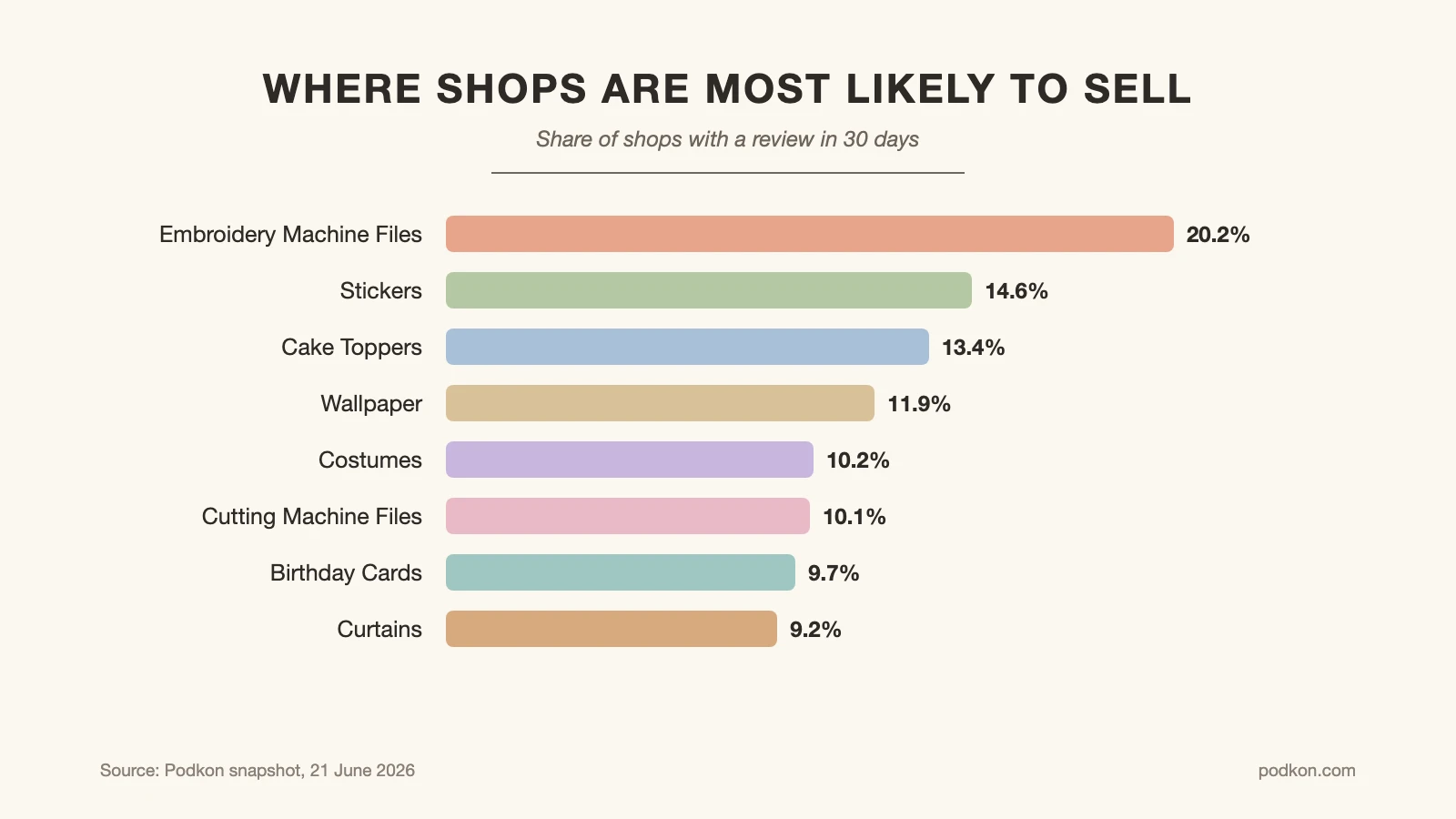
Where the largest share of shops show activity
| Category | Shops with a review in 30 days | Share of shops |
|---|---|---|
| Embroidery Machine Files | 2,085 of 10,310 | 20.2% |
| Stickers | 17,013 of 116,752 | 14.6% |
| Cake Toppers | 1,890 of 14,126 | 13.4% |
| Wallpaper | 434 of 3,638 | 11.9% |
| Costumes | 1,373 of 13,494 | 10.2% |
| Cutting Machine Files | 2,835 of 28,095 | 10.1% |
| Birthday Cards | 3,026 of 31,314 | 9.7% |
| Curtains | 599 of 6,503 | 9.2% |
🔢 Quick Numbers
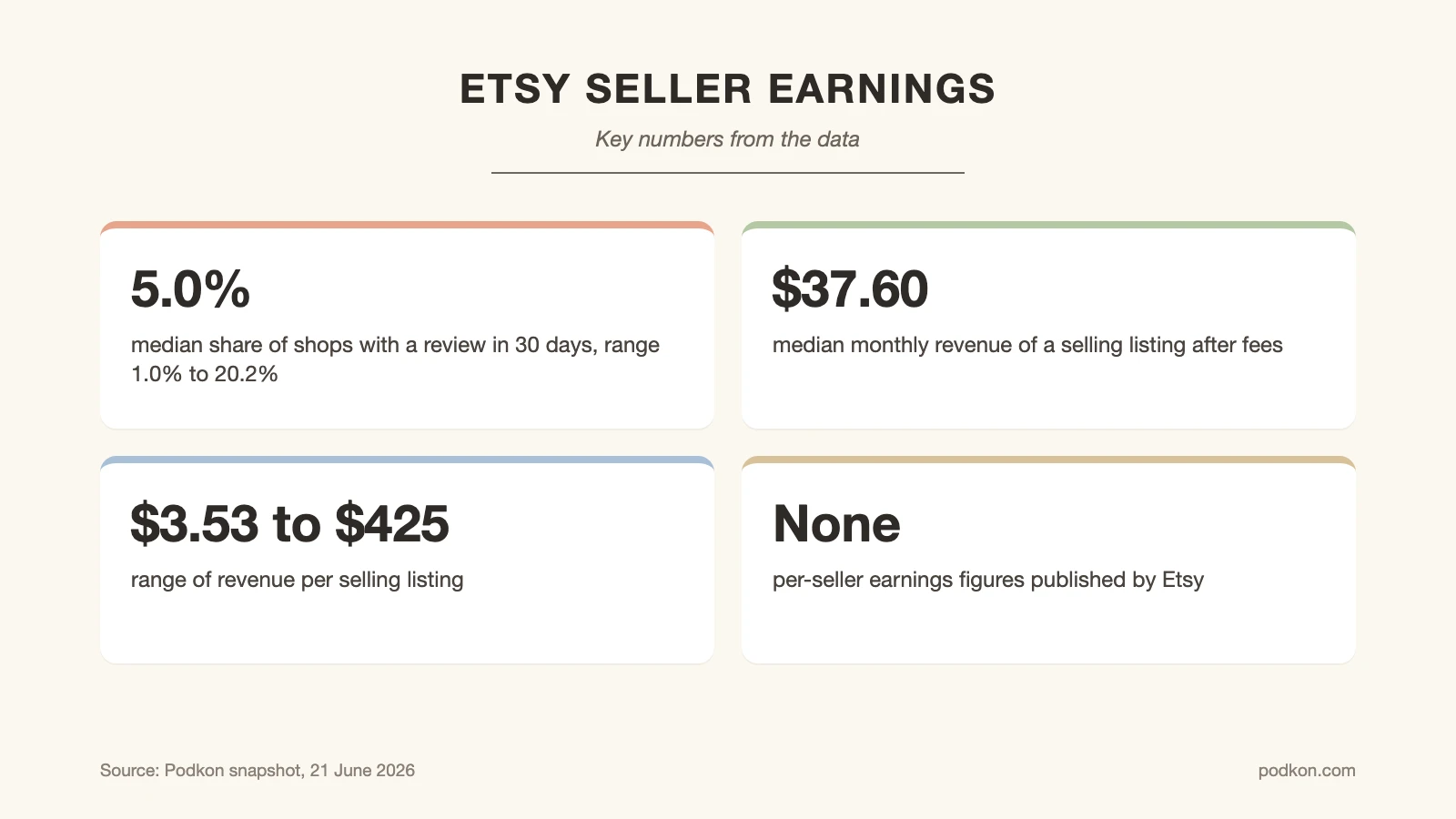
- Median 5.0% of shops in a category showed at least one review in 30 days, range 1.0% to 20.2% (snapshot, 21 June 2026)
- A selling listing generates a median of $37.60 a month after fees, before production cost (snapshot, 21 June 2026)
- Revenue per selling listing ranges from $3.53 to $425.00 across the tracked set (snapshot, 21 June 2026)
- Etsy publishes no per-seller earnings figures (Etsy Q4 and full year 2025 results)
Then multiply by what a listing earns
A listing that sells at all brings in a median of $37.60 a month across the tracked set, after the twenty cent listing fee and the 6.5% transaction fee, and before any production cost. In the cheapest categories that figure is under five dollars; in the most expensive it exceeds four hundred.
So the honest formula for etsy seller earnings is your category’s revenue per selling listing, multiplied by how many of your listings actually sell, minus what it costs you to make and ship them. Every term in that sentence is a variable you influence except the first.
⚖️ Pros & Cons at a Glance
✔️ Pros: the arithmetic is knowable: revenue per selling listing, share of listings that sell, and your own costs are all measurable in your own shop within sixty days
✖️ Cons: no published figure exists for what a typical seller earns, review data understates activity by an unknown multiple, and production cost sits entirely outside this dataset
The second column is why this article gives you a method rather than a number.
📐 Technical Note
Reviews are the only public trace of a completed sale, and review rates vary by category, price and product type. A cheap impulse purchase attracts fewer reviews per sale than an expensive personalised one. Every figure here that derives from reviews therefore understates real activity, and understates it unevenly between categories.
Why Etsy seller earnings averages online are wrong
Published etsy seller earnings figures do not exist at source. Etsy’s reported results cover marketplace level metrics: gross merchandise sales, active buyers, active sellers, take rate. They contain no per-seller earnings figure, so any article quoting an average monthly income for an Etsy shop has constructed it from something else, usually a survey of volunteers or a guess.
What Etsy does report is directional and relevant. Active buyers fell 2.0% in 2025 while active sellers rose 7.7%, per its full year 2025 results. Whatever the typical shop earned last year, the same shop is dividing a slightly smaller buyer pool with more competitors this year.
⚠️ Common Mistake to Avoid
Planning from a headline income figure. The spread in this dataset is more than a hundredfold on revenue per listing alone, before anyone’s costs are considered. A number that averages across 60 categories with medians from $3.50 to $379 describes no real shop, and planning against it produces a business case that cannot survive contact with your actual category.
How to work out your own number
Take sixty days of your own data. Count how many listings received at least one review, divide your revenue by that count, and you have your real figure for revenue per selling listing. Compare it against your category. Then subtract materials, shipping and the hours you spent, which is where most Etsy income calculations quietly stop.
Our pricing walkthrough covers building a price that survives that subtraction, our fee breakdown covers what the platform takes, and our what to sell breakdown covers choosing a category whose economics you can live with.
Etsy’s Seller Handbook covers the operational side, its fee policy sets out every charge, and Statista’s active seller series shows how many others are asking the same question.
Earnings vary widely by category, pricing, production cost and effort. Every figure here describes measured marketplace activity, not what any individual shop will make, and none of it is a projection of your results.
All category figures come from Podkon’s marketplace snapshot dated 21 June 2026 and describe the tracked listing sample, not all of Etsy. Etsy fee rates were current on the Fees and Payments Policy page as last updated 13 February 2026 and can change.
The Bigger Picture
Bottom Line: There is no honest average for etsy seller earnings, and anyone quoting one has made it up. What there is instead is a calculation you can run on your own shop in sixty days, and a category median that tells you whether the answer you get is normal or a problem.