


Etsy Ads can be worth it when you promote proven listings with healthy margins and a click cost your price can absorb, but they quietly burn money when you advertise weak listings or ignore your numbers. The honest answer depends on your margins, your conversion rate, and which products you choose to promote, not on the platform itself.
Most sellers turn on Etsy Ads, set a budget, and then never look at the dashboard again. That is the fastest way to waste money. Paid traffic only multiplies what your shop already does, so a listing that converts at 1% with a thin margin will lose money faster with ads, not slower. This guide breaks down how Etsy Ads and Offsite Ads actually work, how to set a budget, how to read your return, and how to decide listing by listing whether the spend is paying you back.
How do Etsy Ads work?

Etsy Ads is Etsy’s onsite, pay-per-click advertising tool. You set a daily budget, Etsy places your listings in promoted slots across Etsy search, category pages, and market pages on both the web and the app, and you pay a small fee each time someone clicks, whether or not they buy. You never spend more than your daily budget, and you can pause anytime.
The minimum daily budget is $1, and new sellers start with a maximum of $25 per day, which Etsy recalculates weekly based on your recent spend, according to Etsy’s Help Center. Cost per click varies by category and competition, so a quiet niche can sit near the low end while a crowded one like jewelry or wall art runs much higher. You pay for the click, not the sale, which is exactly why the math matters before you switch ads on.
If your daily budget is $25 or more, Etsy now lets you set a strategy per listing instead of one setting for the whole campaign: greater visibility, efficient spending, or lower click cost. That control is useful, but only after you know which listings deserve the budget in the first place.
What are Etsy Offsite Ads?
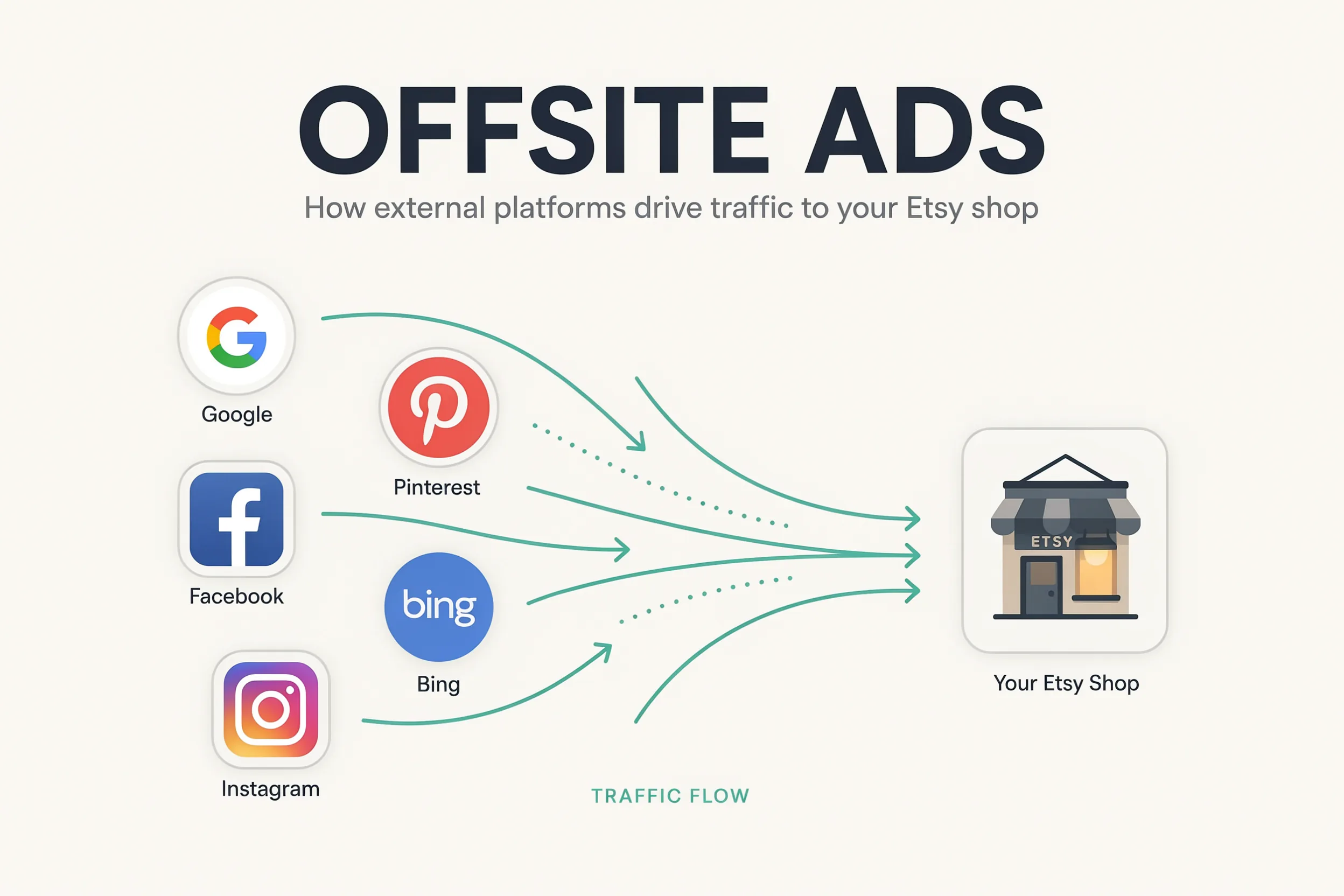
Offsite Ads are separate from onsite Etsy Ads. Etsy advertises your listings on external platforms like Google, Facebook, Instagram, Pinterest, and Bing, and you pay nothing upfront. You are only charged when a shopper clicks one of those ads and buys from your shop within 30 days.
The fee is 15% of the order total if your shop has made less than $10,000 in any rolling 365-day period, or a discounted 12% once you cross $10,000, per Etsy’s Offsite Ads policy. The fee is capped at $100 per order no matter how large the sale. The catch: once your shop passes $10,000 in a 365-day window, participation becomes mandatory for the life of the shop. Below that threshold, you can opt out in your settings. For a full picture of how this stacks with transaction and listing costs, see our breakdown of Etsy seller fees.
🔢 Quick Numbers
- Onsite Etsy Ads minimum daily budget: $1; new-seller default maximum: $25/day (Etsy Help Center, 2026)
- Offsite Ads fee: 15% of order total under $10,000 in a 365-day period, 12% at or above it, capped at $100 per order (Etsy Offsite Ads policy)
- Etsy reported roughly 86.5 million active buyers and 5.6 million active sellers in its full-year 2025 results (Etsy, Inc. Q4 and full-year 2025 results)
How to set an Etsy Ads budget

Start small and let data decide the rest. A $1 to $5 daily budget is enough to gather click and conversion signals without risking much. Run it for two to four weeks before you judge anything, because a handful of clicks tells you nothing. Once you have real numbers, scale the budget toward the listings that earn and pull it from the ones that do not.
Do not spread a small budget across your entire shop. If you advertise 80 listings on $3 a day, every listing gets a few cents and none gets enough traffic to prove itself. Pick your strongest 5 to 15 listings, concentrate the budget there, and let the rest rely on organic search. Strong organic visibility from solid Etsy SEO also lowers your dependence on paid traffic over time.
💡 Seller Tip
Before you raise a budget, check that the listing already converts organically. A common move among sellers who profit from ads is to advertise only items that already sell on their own. Ads amplify a working listing; they cannot rescue a listing that shoppers scroll past.
Reading ACOS and ROAS without guessing
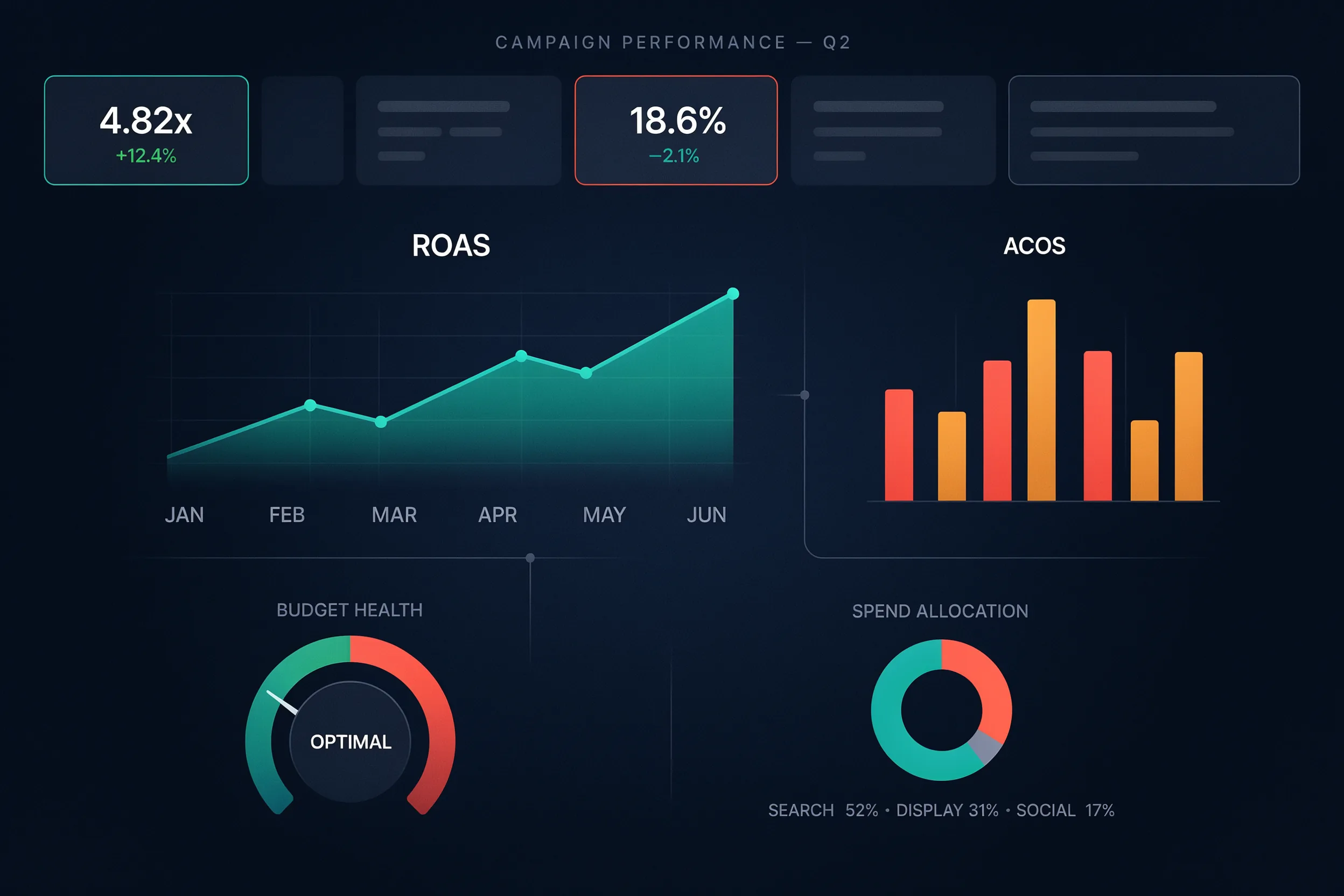
Two numbers tell you whether Etsy Ads are worth it: ROAS and ACOS. ROAS (return on ad spend) is revenue from ads divided by ad spend. A ROAS of 4 means you made $4 for every $1 spent. ACOS (advertising cost of sales) is the inverse expressed as a percentage: ad spend divided by ad revenue. A 25% ACOS means a quarter of your ad-driven revenue went to ads.
Neither number is good or bad on its own. What matters is whether your profit margin can cover it. If your margin after Etsy’s fees and your product cost is 30%, an ACOS of 25% still leaves you a slim profit, while an ACOS of 35% means every advertised sale loses money. Work out your true margin first, then set your break-even ACOS, and treat that as your line in the sand.
Etsy’s Ads dashboard shows clicks, orders, revenue, and spend per listing. Sort by listing, find the ones spending money without orders, and pause them. Find the ones with strong revenue and a comfortable ACOS, and feed them more budget. That single weekly habit separates ads that pay from ads that drain.
⚠️ Common Mistake to Avoid
Judging ads by clicks instead of profit. Plenty of sellers see hundreds of clicks, feel encouraged, and keep spending, while the orders never come. Clicks cost you money; only orders return it. Always measure ads against your break-even ACOS, and pause any listing that spends through several days of budget without a sale.
When do Etsy Ads make sense, and when do they burn money?

Ads make sense when a few conditions line up. Your listing already converts organically, your margin can absorb the click cost, and you want to push a proven seller higher or test demand for a new product with strong early signals. Ads also help new shops gather data quickly, since a fresh listing with no history can struggle to surface in organic search at all.
Ads burn money in the opposite cases. Low margins leave nothing for the click fee. A poor listing with weak photos or a vague title gets clicks but no sales. Advertising your whole catalog spreads the budget too thin to learn anything. And running ads on a saturated, low-price product means the click cost eats your entire profit per order.
⚖️ Pros & Cons at a Glance
✔️ Pros: Fast visibility for new listings; full budget control with a $1 minimum; per-listing strategy at $25/day; pay only for clicks (onsite) or sales (offsite).
✖️ Cons: Easy to lose money on thin margins; offsite participation becomes mandatory above $10,000; click costs rise in crowded niches; needs weekly attention to stay profitable.
Which listings should you actually promote?
Promote your proven winners, not your hopefuls. The listings worth advertising are the ones that already sell organically, have a clear and searchable title, strong photos, and a price that leaves room for the click fee. Those are the listings where paid traffic compounds an existing pattern instead of betting on an unknown.
This is where demand data changes the decision. Instead of guessing which product types pull buyers right now, you can look at what is actually selling across Etsy and lean your ad budget toward proven demand. Pairing ads with solid Etsy product research means you promote items shoppers are searching for, not items you hope they will want.
💡 Seller Tip
Refresh your advertised listings seasonally. Before a gift-heavy stretch like the winter holidays, shift budget toward proven seasonal products four to six weeks early while shoppers are still browsing. Demand peaks faster than most sellers react, so promoting early beats promoting on the day.
Etsy Ads and the rest of your marketing
Ads are one lever, not the whole machine. Free channels often deliver a better long-term return because they keep working after you stop paying. Strong organic search rankings, a steady Pinterest presence, and an email list compound over months in a way paid clicks never do. The smartest approach treats ads as an accelerator on top of those foundations, not a substitute for them.
If your organic traffic is weak, fix that before pouring money into ads, because paid traffic lands on the same listings and the same conversion rate. For the full picture of how ads fit alongside SEO, social, and email, see our Etsy marketing guide.
See what’s selling on Etsy right now
The fastest way to make ads pay is to promote products that already have demand behind them. Podkon tracks live Etsy best-sellers and trends across every category, so you can point your ad budget at proven demand instead of guessing.
The Bottom Line
Bottom Line: Etsy Ads are worth it when you treat them as a tool, not a switch. Promote proven listings with margins that can cover the click cost, start with a small budget, watch your ACOS against your break-even point every week, and cut what does not earn. Run them that way and ads sharpen a working shop. Set them and forget them, and they will quietly hand your profit back to Etsy.