
For Etsy sellers, the printify vs printful decision comes down to one trade-off: Printify is a marketplace of third-party print providers with lower base costs and a bigger catalog, while Printful owns its own factories for tighter quality control and stronger branding. Your best pick depends on whether margin or consistency matters more to your shop.
Both platforms connect to Etsy for free, both ship orders under your shop name, and both can run a print-on-demand business with zero inventory. The differences show up in your profit per sale, how your products feel in a customer’s hands, and how often you field a “this looks off” message. This comparison breaks down product range, pricing, print quality, fulfillment speed, Etsy integration, and branding, then gives you a clear “choose X if” verdict.
One piece of context before the comparison: Printify and Printful are no longer rival companies. They announced a merger in November 2024, and in December 2025 they moved under a single parent named FYUL alongside Snow Commerce. Both brands still run as separate platforms with their own catalogs, base costs and dashboards, so the choice below is still a real one. It does mean the two may converge over time, which is worth remembering if you are picking a platform you expect to stay on for years.
Printify vs Printful at a Glance

Here is how the two platforms stack up on the factors that move the needle for an Etsy shop.
Side-by-Side Comparison
| Feature | Printify | Printful |
|---|---|---|
| Business model | Marketplace of 140+ third-party print providers | Owns and runs its own fulfillment centers |
| Product catalog | 900+ products across many providers | 450+ products, in-house range |
| Base prices | Generally lower, varies by provider | Higher on average, more consistent |
| Paid plan | Premium $39/mo (or $24.99/mo billed yearly), up to 33% off base costs | Growth $24.99/mo, free past $12K/year in sales, up to 33% off |
| Production time | Varies by provider, shown per product | 2 to 5 business days, more predictable |
| Quality control | Depends on the provider you pick | Standardized across all orders |
| Etsy integration | Free, direct connection | Free, direct connection |
Product Range: Catalog Size vs Catalog Control

Printify carries the wider catalog, with more than 900 customizable products pulled from a network of 140+ print facilities across the US, EU, UK, Canada, Australia, and China. If your shop wants a niche item, an unusual mug shape, a specific blanket size, or a regional provider close to your buyers, you can usually find it.
Printful runs a tighter set of 450+ products, but it produces all of them itself. That means the apparel blanks, embroidery options, and home goods stay consistent from one order to the next. For an Etsy shop built on a signature look, fewer surprises matter more than raw catalog size.
💡 Seller Tip
Before you commit to either platform, order a sample of your top product to your own address. Photograph it in natural light and check the print, the fabric weight, and the packaging. The blank you choose affects reviews far more than the platform’s logo on the dashboard.
Pricing and Profit Margins
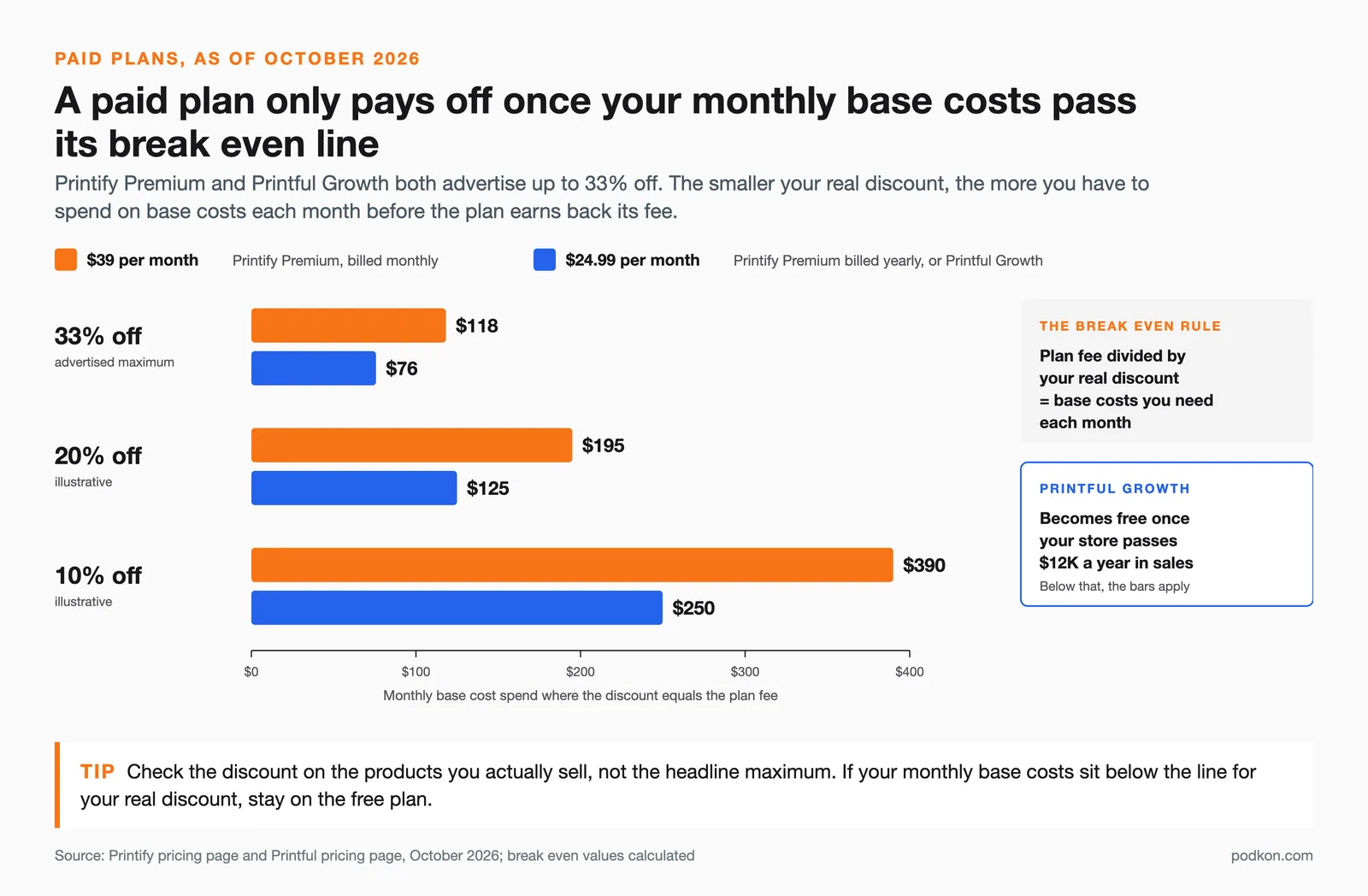
This is where most Etsy sellers feel the real difference. Printify base prices tend to run lower because providers compete for your orders. A classic unisex cotton tee can sit near $8 to $10 before shipping, and Printify Premium can shave up to 33% off base costs from most providers. The catch arrived in February 2026, when Printify raised its Premium plan from $29 to $39 per month, though annual billing still works out to about $24.99 per month ($299 for the year).
Printful sits a little higher on base costs, with popular tees ranging from roughly $9.25 to $13.50 before add-ons. Its single paid tier, Growth, costs $24.99 per month and gives you up to 33% off product pricing. Useful detail for growing shops: Growth becomes free once your store passes $12,000 in yearly sales. You can confirm current numbers on the official Printify pricing page and Printful pricing page, since both adjust rates periodically.
🔢 Quick Numbers
- Printify Premium: $39/mo monthly, or $24.99/mo billed annually, up to 33% off base costs (Printify, 2026)
- Printful Growth: $24.99/mo, free above $12K/year in sales, up to 33% off (Printful, 2026)
- Printful has invested $83.7 million in printing equipment for in-house production (Printful, 2026)
The math for your shop: if you sell high volume on price-sensitive items, Printify’s lower base costs usually win on margin. If your average order value is higher and you sell fewer, premium items, Printful’s consistency can be worth the extra cost per unit.
Print Quality: Who Delivers More Consistent Results?
Printful holds the edge on predictability. Because it owns its facilities and standardizes equipment, the shirt a customer receives in January should match the one shipped in July. That single-source control is the main reason many established Etsy shops accept higher base costs.
Printify quality is not lower by default, but it is variable. Each provider in the network runs its own machines and ranks differently on production time and reliability. The platform shows ratings and recent fulfillment data for each provider, so the quality you get depends heavily on which one you select. Pick a top-rated provider and results can match anything on the market. Pick on price alone and you take on more risk.
⚠️ Common Mistake to Avoid
On Printify, do not auto-route orders to the cheapest provider without checking its rating and production history first. A few cents saved per item is not worth a one-star review for a faded print or a late delivery. Lock in a provider you have tested, and only switch after ordering a sample from the new one.
Fulfillment Speed and Shipping
Printful publishes a clear standard: most orders are produced in 2 to 5 business days before they ship, with domestic US shipping adding another few days on top. Because production happens in-house, that window stays fairly stable, which makes it easier to set honest processing times in your Etsy listings.
Printify production times depend on the provider, and the platform shows each provider’s average fulfillment time over the last 30 days right on the product page. Many top providers match or beat Printful, and Printify offers an Express Delivery option for US orders aiming for two business days. The trade-off is that you have to read those numbers and choose well, rather than relying on one fixed standard.
Etsy Integration: How Easy Is Setup?
Both platforms connect to Etsy for free and sync products, orders, and tracking automatically. You design a product, push it to your Etsy listings, and the platform handles production and shipping when an order comes in. Neither charges a fee just to use the Etsy connection, though Etsy’s own listing and transaction fees still apply, and you pay the platform per fulfilled order.
One practical note on reach: Printful supports a larger set of sales-channel integrations (around 21, including Shopify, Walmart, and TikTok Shop) versus roughly 11 for Printify. If Etsy is your only channel, this barely matters. If you plan to expand to other marketplaces later, Printful gives you more places to plug in without switching tools. For a wider view of your tech stack, see our roundup of the best Etsy seller tools.
📈 Trend Signal
Demand for personalized products keeps climbing on Etsy. Personalization runs through almost every category that sells well here, from apparel to home goods, and it is the clearest way to lift a print-on-demand item above an identical blank. Both platforms support personalization, so the platform choice matters less than picking a niche where buyers are actively searching. Check what is selling now before you design, not after.
Branding and Custom Packaging
For Etsy sellers who want a memorable unboxing, Printful is the stronger option. It offers branded inserts, custom packing slips, inside and outside labels, and more white-label control, all tied to its in-house production. That helps a shop feel like a real brand rather than a generic drop-shipper.
Printify offers branding too, including branded packing slips and neck labels on select products, but the exact options depend on the provider you choose. If a polished, consistent brand experience is core to your shop’s identity, Printful’s single-factory model makes that easier to deliver every time.
Which Should You Choose?
There is no universal winner in the printify vs printful debate. The right answer follows your shop’s priorities.
Choose Printify if you want the lowest base costs and the widest product range, you sell at higher volume on price-sensitive items, you are comfortable vetting providers and reading fulfillment data, and you want providers near your main customer regions. It rewards sellers who are willing to manage the details for better margins.
Choose Printful if you value consistent print quality above all, you want strong branding and custom packaging, you prefer a predictable production window, or you plan to expand beyond Etsy to other channels. It suits shops that want a hands-off, brand-first experience and will accept slightly higher costs for it.
Many experienced sellers run both: Printful for signature, brand-critical pieces and Printify for budget items or products Printful does not carry. Whichever you start with, your real edge is choosing products people actually want. Tools like Printify’s own catalog and our guides on Etsy product research and what to sell on Etsy help you point either platform at proven demand. For a full picture of getting started, see our guide to Etsy print on demand.
⚖️ Pros & Cons at a Glance
✔️ Printify Pros: Lower base costs, 900+ products, provider choice near your buyers. ✖️ Cons: Variable quality, you must vet providers, Premium now $39/mo monthly.
✔️ Printful Pros: Consistent in-house quality, strong branding, predictable speed, more channels. ✖️ Cons: Higher base costs, smaller catalog, less price flexibility.
See what’s selling on Etsy right now
Picking the right platform is only half the job; the design and niche decide whether you sell at all. Podkon tracks live Etsy best-sellers and trends across every category, so you can spot demand before you list. See the live data on best-selling items on Etsy or explore Podkon’s features.
✅ Key Takeaways
- Printify is a marketplace of 140+ providers with lower base costs and a 900+ product catalog; Printful owns its factories for 450+ products with tighter quality control.
- Printify Premium is $39/mo ($24.99/mo billed yearly) with up to 33% off base costs; Printful Growth is $24.99/mo, free past $12K/year in sales, with up to 33% off.
- Printful gives more predictable print quality and stronger branding; Printify quality depends on the provider you select.
- Both connect to Etsy for free; Printful supports more extra sales channels for sellers who plan to expand.
- Choose Printify for margin and range, Printful for consistency and branding, and run both if your product mix calls for it.