


Etsy shipping is the system of profiles, rates, labels, and processing times you set so buyers know what they pay and when their order arrives. Get it right and you protect your margin, qualify for search perks, and avoid late shipments. Get it wrong and shipping quietly eats your profit while slow delivery sinks your reviews.
Shipping is the part of selling that most new shops underprice or ignore until a few orders lose money. The mechanics are not hard, but the defaults rarely match your products. This guide walks through the parts that actually move your numbers: shipping profiles, calculated versus fixed rates, Etsy labels and their discounts, the free shipping guarantee and its ranking effect, international orders, packaging, and processing times. By the end you will know what to set up first and which choices protect your bottom line.
How Does Etsy Shipping Work for Sellers?

At its core, Etsy shipping means you decide three things for every listing: how much the buyer pays to ship, how long you need to prepare the order, and which carrier and service handle delivery. You set these through shipping profiles, then buy a discounted label through Etsy when an order comes in. The buyer sees a price and an estimated delivery window before they check out.
Two pricing models sit underneath all of this. You either charge a fixed amount you set yourself, or you let Etsy calculate the cost based on package weight, size, and the buyer’s address. Most of the decisions in this guide come down to picking the right model for each product and then making sure your prices cover the real cost. If you are still setting up the basics of your shop, start with our guide on how to sell on Etsy, then come back to dial in shipping.
Set Up Shipping Profiles First

A shipping profile is a saved set of shipping rules you apply to many listings at once. Instead of typing rates into every item, you build a profile, for example “Lightweight Prints, USPS, 1 to 3 day processing,” and attach it to each listing that fits. When a carrier rate or your processing time changes, you edit the profile once and every linked listing updates.
Group your profiles by how items actually ship, not by product category. A 2 ounce sticker and a 2 ounce greeting card can share one profile because they cost the same to mail. A heavy ceramic mug needs its own. Etsy walks through the fields in its guide to setting up shipping information, but the strategy is yours: fewer, well-organized profiles are far easier to maintain than one profile per item.
💡 Seller Tip
Name your profiles by weight band and processing time, not by product. A name like “Under 4oz, 1 to 2 day prep” tells you instantly whether a new listing fits an existing profile. Top sellers usually run a handful of clean profiles, which keeps rate updates fast when postage prices change.
Calculated vs Fixed Shipping: Which Should You Use?

Calculated shipping pulls a live rate from the carrier using your package weight, dimensions, and the buyer’s location, so the buyer pays close to the true cost. Fixed shipping is a flat amount you set yourself, the same for every buyer in a zone regardless of distance. Each fits a different kind of product.
Calculated shipping works best for heavier or bulky items where distance changes the cost a lot, like pottery, candles, or framed art. It protects you from undercharging a cross-country order while keeping nearby orders cheap for the buyer. The catch is that it is available to US and Canada based sellers using USPS or Canada Post, and you must enter accurate weight and dimensions. Etsy explains the requirements in its calculated shipping help article.
Fixed shipping suits light, uniform items where the cost barely changes, like stickers, prints, or jewelry that fits a standard envelope. It is simpler and works for sellers outside the calculated shipping regions. The risk is guessing too low and paying the difference yourself on distant orders. Here is how the two compare at a glance.
Calculated vs Fixed Shipping

| Factor | Calculated Shipping | Fixed Shipping |
|---|---|---|
| Who can use it | US and Canada sellers on USPS or Canada Post | Any seller, any carrier |
| Best for | Heavy or bulky items | Light, uniform items |
| Buyer pays | Live rate by weight and distance | Flat amount you set |
| Main risk | Wrong weight or size data | Undercharging distant orders |
| Upkeep | Mostly automatic | Manual review as postage rises |
Etsy Shipping Labels and Discounts

When you buy a shipping label directly through Etsy, you get discounted rates that are usually lower than counter prices at the post office, and the tracking is added to the order automatically so the buyer can follow it. Buying labels in Etsy also marks the order as shipped, which feeds the on-time delivery signals Etsy watches.
The workflow is simple: open the order, confirm the package weight and size, choose the service, and print. Etsy supports multiple carriers depending on your country, and the discount comes from Etsy’s bulk rates passed on to sellers. Weigh finished, packaged items on a small kitchen or postal scale rather than guessing, because an underweight label can mean a postage-due surprise or a returned package.
⚠️ Common Mistake to Avoid
Setting a flat shipping price once and never revisiting it. Postage rates climb, your packaging changes, and the flat fee you set last year may now run a loss on every heavier or farther order. Recheck your real label cost against what you charge at least a few times a year, and after any carrier price increase.
The Free Shipping Guarantee and Its Ranking Effect
The free shipping guarantee means buyers pay no shipping on orders of $35 or more shipping within the US. You can turn it on for your whole shop, and it applies to both US sellers and international sellers shipping to US buyers. The cost does not disappear, you absorb it or build it into your prices, but it comes with a real visibility benefit.
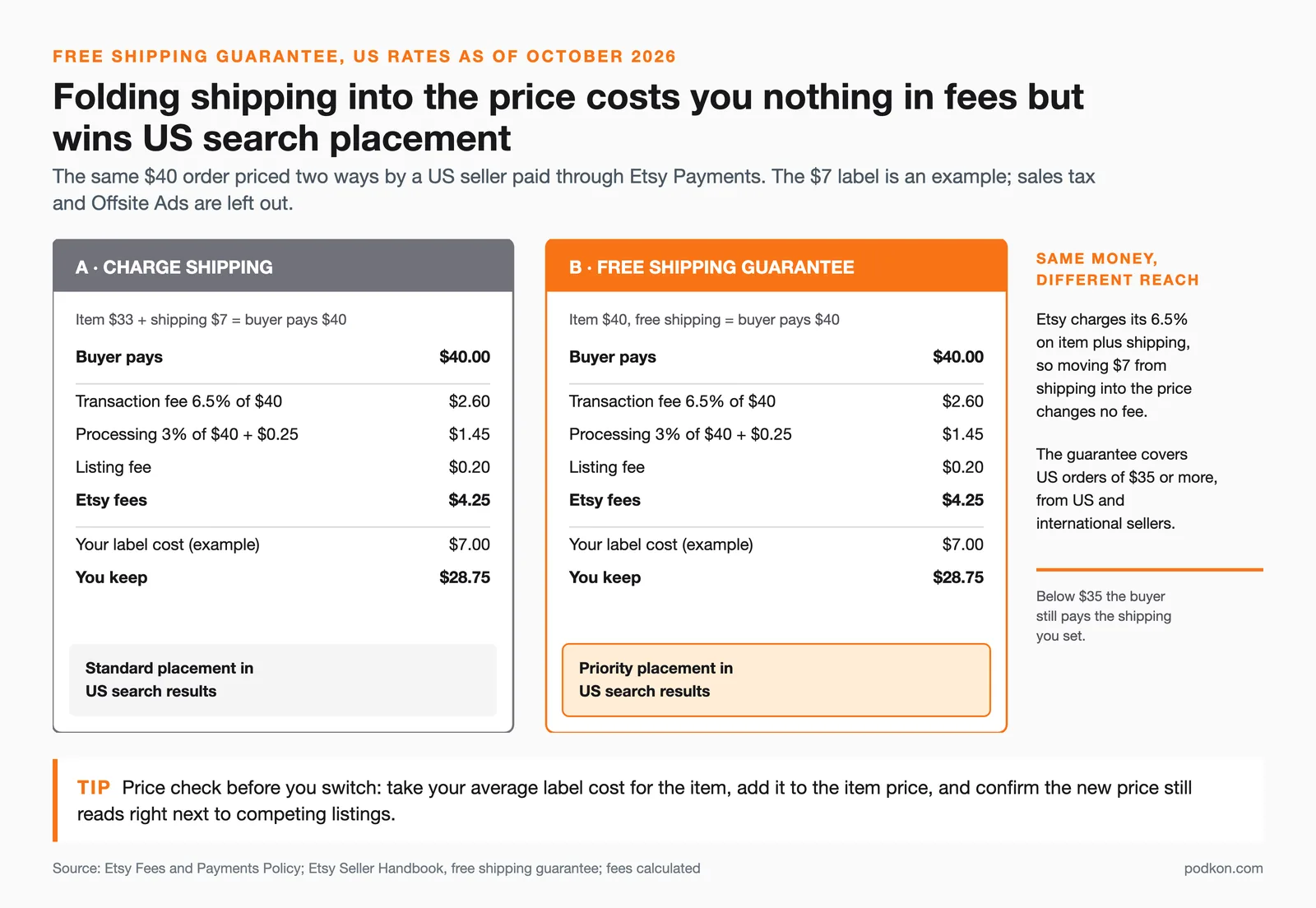
Etsy gives priority placement in US search to listings that qualify for free shipping on orders over $35, which is the reason the feature matters beyond buyer appeal. Etsy describes this boost in its Seller Handbook article on the free shipping guarantee and priority placement, and the setup steps live in its how to offer free shipping guide. The smart move is to raise item prices enough to cover shipping rather than eat it, so you keep the search advantage without losing margin.
📌 Did You Know?
Free shipping is a buyer expectation, not just a nicety. Etsy rolled out the $35 free shipping guarantee specifically because shipping cost is one of the top reasons shoppers abandon carts, and it ties qualifying listings to better US search placement, per Etsy’s own Seller Handbook. Building shipping into your price is how sellers offer it without losing money.
Free shipping interacts directly with how you price, so do not set it in isolation. Work the shipping cost into your full pricing math, including Etsy’s fees, before you flip it on. Our guides on Etsy fees and how to price Etsy products show how to fold shipping into a price that still clears a profit.
International Shipping: Worth the Reach
Opening your shop to international buyers widens your market, but it adds steps. You set separate rates for each region or country, customs forms become part of the process, and delivery times stretch. Etsy can generate customs documentation when you buy eligible international labels, which removes much of the paperwork friction.
Start small if international feels daunting. Add one or two nearby regions first, set realistic delivery windows so buyers are not surprised, and state clearly in your policies that customs fees or import duties are the buyer’s responsibility. As orders come in, you learn which destinations are worth keeping and which create too many delays or lost packages to be worth the rate you charge.
💡 Seller Tip
For print on demand and digital-adjacent products, let your production partner handle fulfillment and shipping where possible, so distance stops being your problem. If you run a POD shop, our guide on Etsy print on demand covers how that workflow changes your shipping setup entirely.
Packaging and Processing Times That Protect Your Reviews
Processing time is the window you give yourself to prepare and ship an order, and Etsy shows it to buyers as part of the delivery estimate. Set it honestly. A 1 to 3 day processing time you can actually hit beats a 1 day promise you miss, because late shipments hurt both your reviews and Etsy’s read on your reliability.
Packaging is where small costs and big impressions meet. Use materials that survive transit without overspending, since padding, mailers, and tape all come out of your margin. For fragile items, the cost of solid packaging is far lower than the cost of a broken-arrival refund plus a bad review. Etsy’s guide to shipping covers carrier and packaging basics if you want a deeper reference.
Build a small buffer into your processing time for busy weeks. Orders cluster around holidays and sales, and the processing window that works in a quiet month can slip when ten orders land in a day. A realistic time that you beat is better for your shop than an aggressive one you miss, and consistent on-time shipping is one of the quieter signals that keeps your listings healthy in search, alongside a solid Etsy SEO foundation.
See what’s selling on Etsy right now
Shipping math is easier when you know what buyers in a niche already pay and how the top shops package and price their orders. Podkon tracks live Etsy best-sellers and trends across every category, so you can check live trends before you set your rates. Explore what the tool surfaces on the features page.
✅ Key Takeaways
- Build a few clean shipping profiles grouped by weight and processing time, not by product type.
- Use calculated shipping for heavy or bulky items and fixed shipping for light, uniform ones.
- Buy labels through Etsy for discounted rates, automatic tracking, and on-time delivery signals.
- The $35 US free shipping guarantee earns priority search placement, so build the cost into your prices.
- Set honest processing times with a buffer for busy weeks, and recheck flat rates whenever postage rises.