


To learn how to sell on Etsy, you create a seller account, pay the one-time set-up fee, pick products that already have proven demand, open your shop, build listings with strong photos and keyword-rich titles, price for profit after fees, and ship reliably to earn reviews. The order matters: validate demand before you build anything.
Most beginner guides tell you to “follow your passion” and start listing. That advice skips the step that decides whether your shop earns money. With 5.6 million active sellers competing for 86.5 million active buyers as of December 31, 2025, according to Etsy’s 2025 annual report, picking the right product is the difference between a shop that gets found and one that gets buried. This guide walks you through the full path, from idea to first sale to scaling, with the demand-checking step built in.
Step 1: Decide what to sell (and validate the demand first)

Your product choice carries more weight than your logo, your shop name, or your packaging. A great listing for something nobody searches for still earns nothing. So start by checking real demand before you invest time or money.
Three product types work well for new sellers because they keep startup costs low:
- Digital downloads (printables, planners, templates, SVGs): no inventory, no shipping, instant delivery.
- Print on demand (shirts, mugs, wall art): a partner prints and ships per order, so you hold no stock.
- Handmade or craft goods: higher margins if you already have the skill, but more time per order.
Digital and print on demand let you test ideas cheaply, which matters when you are still learning what your audience wants. You can list a new design, see how it performs, and drop it without losing money on stock. Handmade goods reward sellers who already have a craft and want to turn it into income, since the labor is the product. Many shops blend types, for example selling a handmade item alongside a matching digital version.
Whichever route you pick, check that buyers are actively searching for it. Look at how many recent sales similar listings show, whether search interest is rising or fading, and how saturated the niche already is. A category packed with 200,000 near-identical listings is far harder to break into than a rising sub-niche with steady sales and fewer sellers. For a deeper framework on choosing, see our guide on what to sell on Etsy, and learn the validation method in our walkthrough on how to validate Etsy demand.
⚠️ Common Mistake to Avoid
New sellers often build a full product line around a personal favorite, then wonder why nothing sells. The fix is simple: confirm there is real, current search demand before you create the first listing. Spend an afternoon studying what buyers in your niche are actually purchasing, not what you assume they want.
Step 2: Open your Etsy shop

Setup is quick once you know what to sell. From Etsy’s seller page, the steps are:
- Create an Etsy account and click “Open your Etsy Shop.”
- Set your shop language, country, and currency.
- Choose a shop name (4 to 20 characters, no spaces or special characters).
- Pay the one-time set-up fee of $15 USD, introduced in 2024 to raise seller commitment.
- Create at least one listing, then add a payment method and billing card.
Pick a shop name you will not outgrow. A name tied to one narrow product (for example “VintageCatMugs”) boxes you in if you expand later. Something broader gives you room to add categories without rebranding.
Before you go live, finish the parts of the shop buyers actually read. Write a short About section that explains who makes the items and why, set clear shop policies for returns and processing time, and add a profile photo or logo. These build the trust a brand-new shop has not yet earned through reviews, and they take an hour to set up once.
How much does it cost to sell on Etsy?
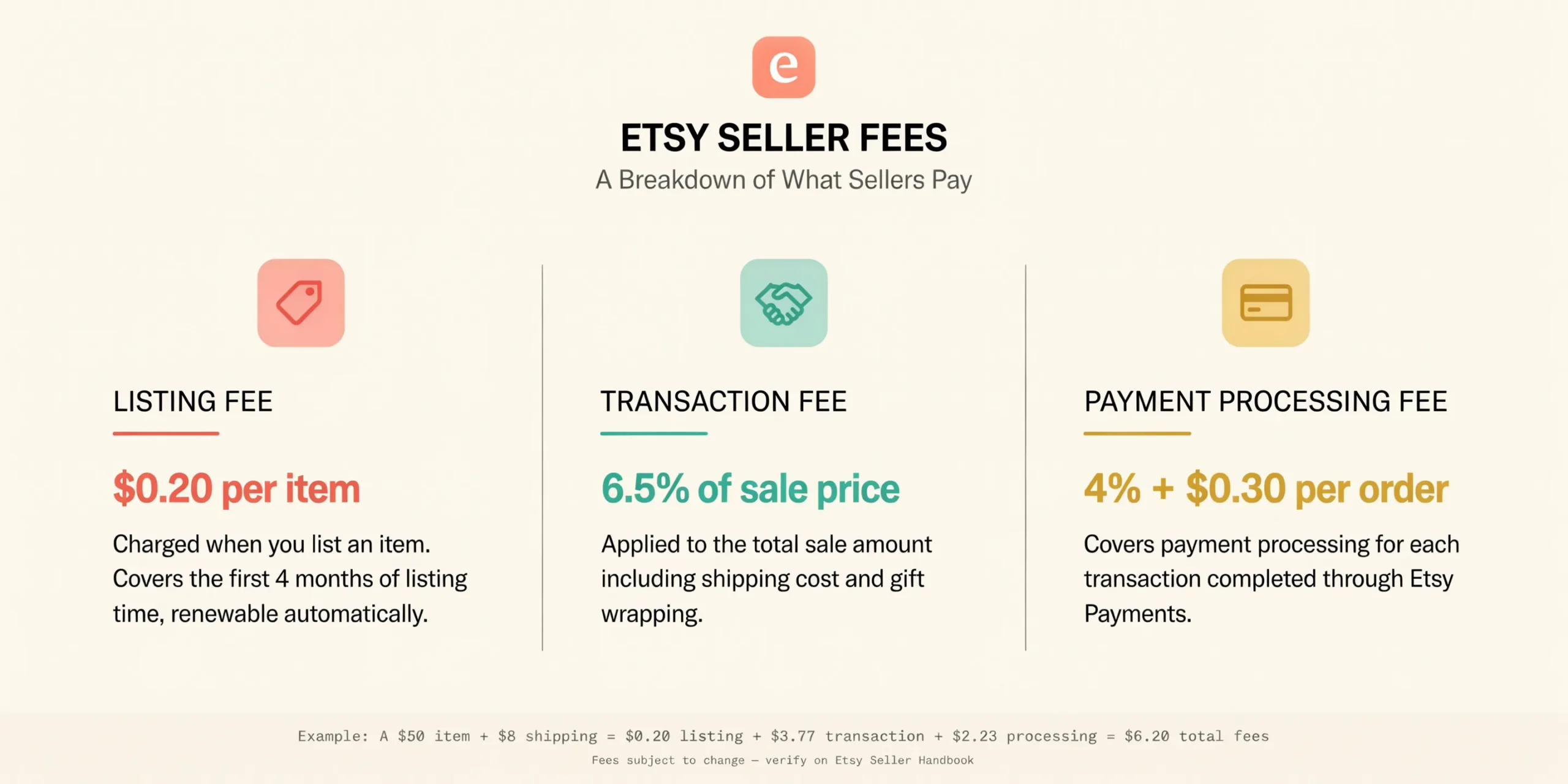
Etsy charges per listing and per sale rather than a flat monthly fee, so your costs scale with your sales. Knowing every fee up front keeps your pricing profitable. Here is the 2026 breakdown for US sellers, drawn from Etsy’s official fee documentation.
Etsy seller fees at a glance

| Fee | Amount | When it applies |
|---|---|---|
| One-time set-up | $15 USD | Once, when you open the shop |
| Listing fee | $0.20 per listing | Per listing, expires after 4 months |
| Transaction fee | 6.5% | On item price plus shipping per sale |
| Payment processing | 3% + $0.25 | Per sale via Etsy Payments (US) |
| Offsite Ads | 12% or 15% | Only on sales from Etsy’s external ads |
A rough rule: between the transaction fee, processing, and listing cost, plan for Etsy to take roughly 10% to 11% of a typical order before any optional ads. Build that into your price from day one.
⚠️ Common Mistake to Avoid
Pricing an item at your material cost plus a small markup, then losing the margin to fees. Etsy’s 6.5% transaction fee applies to shipping too, so free shipping is never truly free. Add expected shipping cost into the item price when you offer it.
Step 3: Create listings that get found

A listing has three jobs: appear in search, earn the click, and convince the buyer. Each piece below does one of those jobs.
Photos: your first and biggest conversion lever
Buyers judge in seconds. Use all available image slots. Show the product on a clean, well-lit background, then add lifestyle shots (the item in use), a scale reference, and a close-up of detail. Natural daylight and a plain backdrop beat an expensive camera. For digital products, mock up the file on a device or in a frame so buyers can picture the result.
Titles and tags: how Etsy search finds you
Etsy ranks listings on relevance, so your title and 13 tags need the words buyers actually type. Lead the title with the clearest phrase for your item (“Personalized Dog Mom Tumbler” beats “Cute Gift for Her”). Fill all 13 tags with multi-word phrases, not single words, and avoid repeating the same root term. Match tags to buyer language, not industry jargon. Our Etsy SEO guide covers keyword placement in depth.
💡 Seller Tip
A common move among top sellers is to write the description for the buyer in the first two lines, then for search below. Open with the benefit and key details a shopper needs, since Etsy shows only the first lines on mobile. Save the longer keyword-rich copy for further down.
Description and attributes
Answer the obvious questions: size, materials, what is included, processing time, and how it ships or downloads. Fill every category attribute Etsy offers, because those fields feed both search filters and discovery.
Step 4: Price for profit, not just for sales
Underpricing is the fastest way to burn out. Start from a real cost base, then add margin on top, then check the result against fees.
A workable formula for physical goods: (materials + labor + overhead) multiplied by 2, then add packaging and your expected Etsy fees. For digital products, where there is no per-unit cost, price by value and by what comparable listings sell for, not by “it took me an hour.” Round to clean price points and test. You can always run a sale rather than start too low.
💡 Seller Tip
Before you set a final price, look at the top few sellers for your exact product and note their range. If you price far below them, buyers may read your item as lower quality. Match the band and compete on photos and reviews instead.
Step 5: Set up shipping basics
Shipping confuses many new sellers, so keep it simple at first. Weigh and measure your packaged product, then use Etsy’s calculated shipping so each buyer pays the real rate for their address. Set an honest processing time you can hit every order, since late shipping hurts your reviews and your search standing.
Free shipping is a strong filter and a buyer expectation in many niches, but only offer it when you have folded the cost into the item price. For digital downloads, there is no shipping at all, which removes a whole layer of risk for beginners.
How do you get your first sale on Etsy?
You get your first sale by being findable and trustworthy at the same time. A brand-new shop has no reviews and little search history, so you give Etsy and buyers reasons to choose you. Three moves help most:
- Launch with 10 to 20 listings, not one. More quality listings mean more entry points from search.
- Share your shop where your buyers already are. Relevant communities, Pinterest, and your own network drive the early traffic Etsy search cannot yet send.
- Respond fast and ship early. Your first few reviews carry outsized weight, so over-deliver on the first orders.
📌 Did You Know?
Etsy’s seller base dropped from about 9 million in 2023 to 5.6 million by the end of 2025, after Etsy added the one-time set-up fee, according to its 2025 annual report. Fewer casual sellers means buyers still arrive in large numbers (86.5 million active buyers), so a committed new shop faces less low-effort competition than it did a few years ago.
Step 6: Scale once the basics work
Once you have a few sales and reviews, growth comes from doing more of what already works. Track which listings sell, then expand those into variations and related products rather than chasing brand-new categories. Keep adding listings, since each one is another path from search to your shop.
Reinvest early profits into the things that compound: better photography, a wider set of listings, and tools that save you time on repetitive work. Etsy’s own advertising can extend reach once a listing already converts, but turn it on only after a listing sells well organically, so you are amplifying a winner rather than paying to test a guess.
This is also where staying on top of demand pays off. Trends shift through the year, and the sellers who add the right seasonal or rising product early capture the search traffic before the niche floods. Watching what’s currently selling on Etsy turns scaling from guesswork into a repeatable habit.
See what’s selling on Etsy right now
Choosing what to sell is the step that decides everything else in this guide, and guessing is expensive. Podkon tracks live Etsy best-sellers and trends across every category, so you can spot demand before you list.
📚 See also: before you commit, read whether Etsy is still worth it in 2026, measured against four public numbers.
Putting It All Together
✅ Key Takeaways
- Validate real demand before you build anything; product choice outweighs branding.
- Opening a shop costs a one-time $15 set-up fee, then $0.20 per listing plus per-sale fees.
- Expect Etsy to take roughly 10% to 11% per order, so price with fees and shipping built in.
- Photos win the click; titles and 13 tags win the search ranking.
- Launch with 10 to 20 listings, ship early, and protect your first reviews.
- Scale by expanding proven listings and tracking current demand, not by guessing.