

Etsy tags are 13 short keyword phrases you add to each listing that tell Etsy search what your product is and which shopper queries it should match. Use every slot, fill them with multi-word phrases buyers actually type, mirror your title, and skip duplicates. Done right, your 13 tags widen the number of searches your listing can appear in.
Most sellers treat tags as an afterthought, stuffing in single words like “mug” or “gift” and calling it done. That wastes the strongest free ranking lever Etsy gives you. Each tag is a separate chance to be matched, so leaving slots empty or repeating yourself quietly shrinks your reach. This guide shows you how to fill all 13 with intent, tie them to your titles, and refresh them based on what shoppers are searching for right now.
How do Etsy tags work in search?
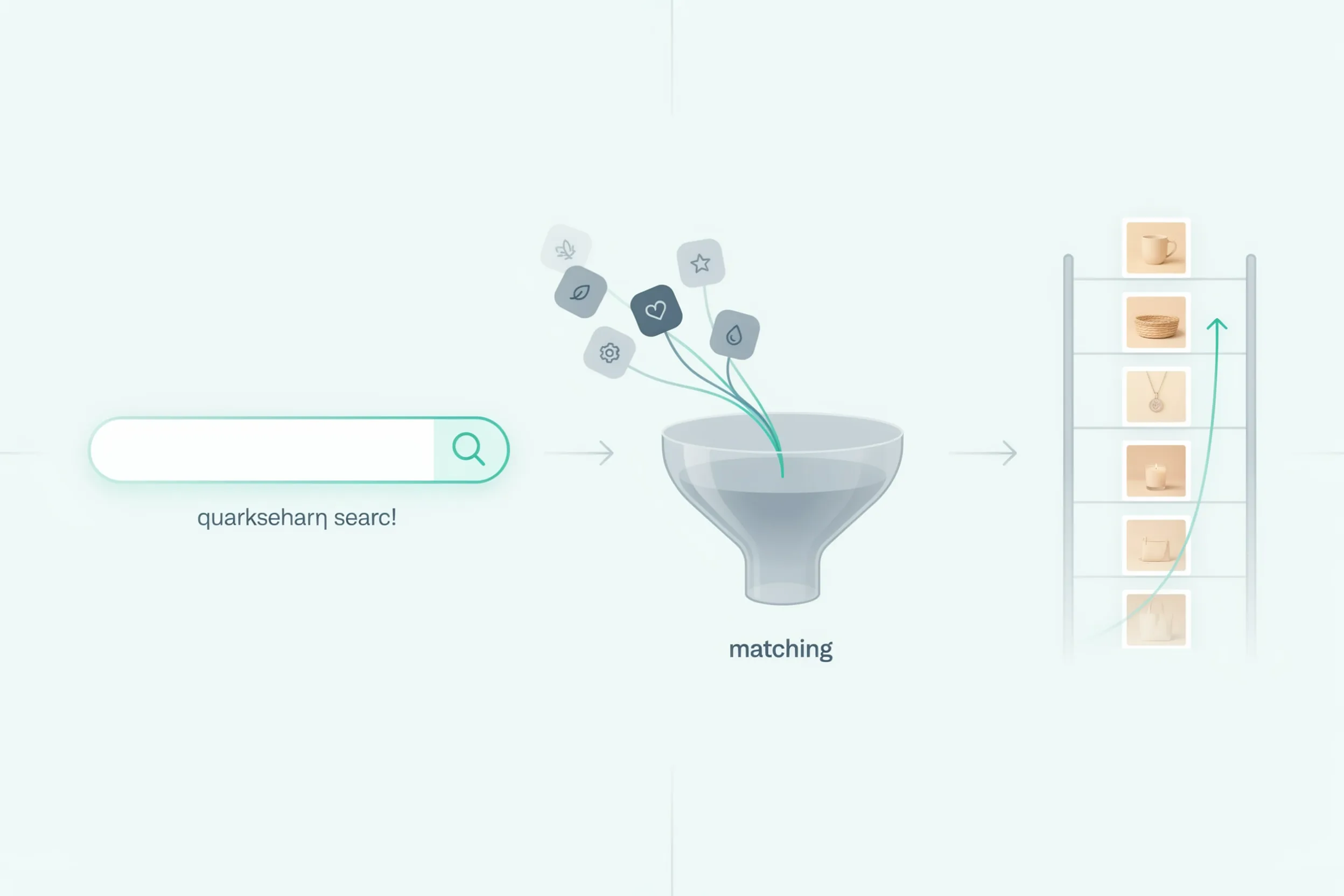
Etsy search runs in two stages: query matching, then ranking. First, the system gathers every listing whose keywords match what a shopper typed. Then it ranks those listings by relevance and quality. Your tags, along with your title, categories, attributes, and description, decide whether you make it into that first pool at all. If none of your fields match the query, you cannot rank for it, no matter how good your photos or reviews are.
According to Etsy’s “How Etsy Search Works” guide, the system looks at the whole listing, including title, tags, attributes, description, first photo, and reviews, to connect items with the right buyers. Tags are the part of that picture you fully control on every listing, and you get 13 of them.
One detail that trips up new sellers: each tag can be up to 20 characters, and Etsy reads the full phrase. A tag like “personalized dog mug” is one matchable phrase, not three loose words. That is why how you group words inside each slot matters as much as which words you pick. For the broader picture of how titles, tags, and attributes fit together, see our Etsy SEO guide.
💡 Seller Tip
Before you list, read your draft tags out loud as if you were a shopper typing into the search bar. If a phrase sounds like something nobody would search (“beautiful,” “high quality,” “unique”), cut it and replace it with a phrase a buyer would actually type, like “minimalist gold ring” or “cottagecore wall art.”
Why you should use all 13 tags
Every empty tag slot is a search you can never appear in. Etsy is direct about this: each tag you add is an opportunity to be matched with a shopper’s search, so use all 13. There is no downside to a full set, and no bonus for holding any back. If you have only six strong phrases in mind, that is a signal to do more keyword research, not to stop at six.
Think of the 13 slots as 13 separate doors into your listing. A buyer searching “boho nursery print” walks through one door; a buyer searching “neutral baby room decor” walks through another. Both can land on the same listing if you tagged for both. Cap yourself at a handful of obvious terms and you close most of those doors before anyone knocks.
📌 Did You Know?
Etsy honors common regional spellings automatically. Per Etsy’s Keywords 101, a shopper searching “jewellery” will still see listings tagged “jewelry,” so you do not need to spend a slot on both spellings. You do, however, need to add genuinely different regional terms, like “thong sandals” for Australian buyers searching for flip flops.
Use multi-word, long-tail phrases

Single words are almost always too broad to rank for. Etsy recommends using multi-word phrases instead of stacking single words, because a tag like “custom bracelet” is stronger than separate “custom” and “bracelet” tags, and it frees up a slot for another phrase. Long-tail phrases (three to four words) face less competition and match shoppers who are closer to buying.
Compare the search “ring” against “stacking birthstone ring.” The first is a flooded query dominated by giant shops; the second is specific, lower in competition, and signals a buyer who knows what they want. Your tags should lean toward those specific, intent-rich phrases. Save the broad heads of the long-tail for your categories and attributes, which already cover them.
How to build a strong 13-tag set

Work from specific to broad and group your phrases so every slot earns its place:
- Core descriptive phrases: what the item literally is, in buyer language (“linen apron,” “ceramic coffee mug”).
- Style and aesthetic: the look shoppers search by (“cottagecore decor,” “minimalist jewelry,” “y2k sticker”).
- Use case and occasion: why someone buys (“housewarming gift,” “bridesmaid proposal,” “desk organizer”).
- Recipient: who it is for (“gift for mom,” “gift for him,” “teacher gift”).
- Material or technique: details buyers filter by (“hand poured candle,” “sterling silver chain”).
If you sell physical or digital products and need help finding which of these phrases have real demand, our walkthrough on Etsy product research covers how to validate terms before you build a listing around them.
Match your tags to your titles

Tags and titles work as a team, not in isolation. Etsy looks at both when matching a query, and exact-phrase matches across your title and tags reinforce relevance. The practical move is to make your most important multi-word tag phrases appear in your title too, written naturally for a human reader.
If your strongest tag is “personalized leather wallet,” that phrase should also live near the front of your title. The title speaks to shoppers scanning results; the tags catch the long-tail variations you cannot fit in a readable title. When the two line up on your priority phrases, you send Etsy a consistent signal about what the listing is.
⚠️ Common Mistake to Avoid
Repeating the same words across your 13 tags wastes slots. Tags like “octopus art” and “octopus print” overlap heavily and reach almost the same searches. Etsy’s own example favors spreading out: “octopus art print” plus “animal wall decor” puts that listing in front of two distinct audiences. Make all 13 as different from each other as you can.
Avoid wasted and duplicate tags

A wasted tag is any slot that does not add a new searchable phrase. The usual culprits are single generic words, phrases no one searches, near-duplicates of another tag, and terms already fully covered by your categories and attributes. Etsy’s attributes (like color, occasion, or holiday) are matched in search the way tags are, so re-tagging the exact same attribute is redundant. Spend those freed slots on phrases your attributes do not capture.
Run a quick audit on any listing: list your 13 tags in a column and check whether each one reaches a search the others miss. If two tags would pull the same results, one of them is dead weight. Swap it for a synonym, a different style angle, or a new occasion.
Plurals, synonyms, and how shoppers phrase things

Etsy handles some variation for you, but not all of it. The system is generally smart about close variants, so you rarely need both “sticker” and “stickers” in separate tags. Where you should spend effort is on true synonyms and alternate phrasings buyers genuinely use. “Wall art,” “wall decor,” and “wall hanging” can pull different crowds; “planner” and “organizer” attract different searches. Pick the variants real shoppers type, not every dictionary alternative.
The safest way to find these is to watch Etsy’s own search bar autocomplete and your competitors’ best sellers, then confirm the phrases are pulling traffic. A tool that surfaces live demand saves you from guessing, which is where tag refresh comes in.
Refresh tags based on what is actually selling

Tags are not set-and-forget. Search behavior shifts with seasons, trends, and how buyers describe things, so the phrases that matched in spring may go quiet by fall. Etsy recommends consulting your Shop Stats and refreshing the tags on listings that are getting less traffic, diversifying the terms you use. Treat a listing’s stats as a feedback loop: the searches that bring visits are working, and the ones bringing nothing are candidates to replace.
💡 Seller Tip
A common move among top sellers is to refresh tags on slow listings in small batches rather than rewriting everything at once. Change a few tags, give it two to three weeks, and check Shop Stats for movement. Changing every tag overnight makes it impossible to tell which swap actually helped.
The hard part is knowing which new phrases are worth testing. Your own stats tell you what already works for you, but they cannot show you the demand you are missing across the wider market. That is where tracking live trends pays off: you can see which terms and product styles are climbing before you bake them into your tags. Our overview of what’s selling on Etsy is a good place to start spotting those shifts, and a dedicated tracker turns it into a routine.
For sellers who want to systematize this, it helps to pair tag research with the right software. Our roundup of the best Etsy seller tools compares options for keyword and trend research so you can refresh tags from data instead of hunches.
See what’s selling on Etsy right now
Good tags start with knowing which phrases and products are gaining traction this week, not last year. Podkon tracks live Etsy best-sellers and trends across every category, so you can find your next tag before you list.
Putting It All Together

✅ Key Takeaways
- Fill all 13 tag slots; every empty one is a search you can never appear in.
- Use multi-word, long-tail phrases (three to four words) instead of single broad words.
- Mirror your top tag phrases in your title so Etsy gets a consistent relevance signal.
- Make all 13 tags distinct; near-duplicates and attribute repeats are wasted slots.
- Let Etsy handle plurals and regional spellings; spend slots on true synonyms buyers type.
- Refresh tags on low-traffic listings in small batches using Shop Stats and live trend data.
You do not need clever tags. You need 13 distinct phrases a real buyer would type, lined up with your title and kept fresh as demand moves. For the next layer, connecting strong listings to promotion and traffic outside search, see our Etsy marketing guide, or explore how Podkon’s trend features fit into your tagging workflow.